Avionics
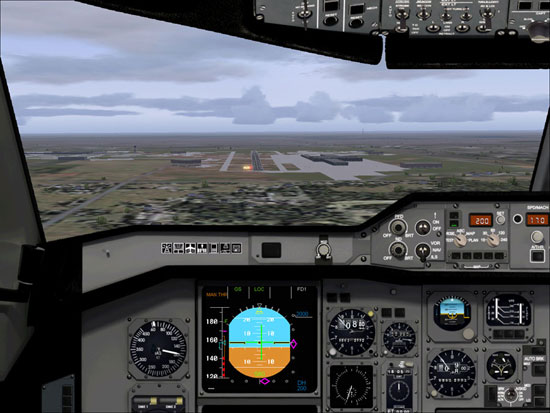
Regarding avionics, I like the Airbus for presentation and the Boeing for functionality. The A310 is the clear winner for me as far as how the instruments fit into the panel and how they are integrated into the scan. The 767 and 727 both suffer from a bit of lack of Feng Shui. By that I mean the gauges don’t line up as neatly as the A310/320. Take a look at the 767 VSI for gosh sake, its offset from under the analog altimeter by an inch! The eyebrow panel where the autopilot parameters are set is a bit cleaner looking on the Airbus as well; the 767 has white radial spokes coming off their selectors making it appear more like a game of Chutes and Ladders than a serious tool for flying the airplane.
Autopilot
With all of that said about appearances, the actual implementation of the 767 autopilot controls and modes seems more logical and straight forward to me. Despite the fact that modern avionics and autopilots are designed to make flying the aircraft safer, more efficient, and less fatiguing on the pilot, there is a lot to be said for the increasing instances of “mode confusion” or the “what is it doing now?” factor. Setting up approaches, climbs, descents, VNAV and LNAV modes just seemed more intuitive to me in the 767. Not only were they more easy to set up, the LD767 responded much more favorably to autopilot directions than the A310/320. The 727 obviously suffers from a lack of automation and the fact that the flight director and auto-pilot aren’t necessarily showing you the same thing can be a bit baffling at first.


Displays
The A320 and the 767 tie for EFIS tube presentation. The selectable V-bar style flight director on 767 is far better than the cross type FD on the Airbus (personal preference). Unfortunately, Boeing gets a big “thumbs down” on their EICAS implementation. It is effective, and it is functional, but it sure is bare bones. Compared to the incredible graphical genius of the A310/A320 ECAM displays, the 767 just doesn’t measure up. The ease of flipping through the Airbus ECAM pages to see what each specific system is doing is a great feature. The electrical, hydraulic and pressurization diagrams make it very easy to diagnose switch settings and problems in an instant. The old saying “a picture tells a thousand words” is very true in this case. Of course, both the Airbus and the 767 might, in real life, lose out to the wisdom of a grey haired Flight Engineer (727) that can both diagnose and verbalize a problem better than an ECAM page. Of course, the quality of an FE varies from day to day based on who you are flying with and how late you stayed out the night before, so perhaps the steadfast monitoring provided by the EICAS is better!
 |
 |
The inclusion of the right side panel on the LD767 gets high praise. It isn’t just pretty; it’s functional and helps with maintaining situational awareness during high workload phases of flight. Both the SSW A310 and PSS A320 have superb “landing” view panels (something all add-ons should have) that increase forward visibility for landing while maintaining good views of the flight instruments.

Related Posts:

Related posts:
 Boeing vs. Airbus – Part 1 Simulation Software Workshop Airbus A310 Page 2
Boeing vs. Airbus – Part 1 Simulation Software Workshop Airbus A310 Page 3
Boeing vs. Airbus – Part 1 Simulation Software Workshop Airbus A310 Page 7
Boeing vs. Airbus – Part 1 Simulation Software Workshop Airbus A310 Page 2
Boeing vs. Airbus – Part 1 Simulation Software Workshop Airbus A310 Page 3
Boeing vs. Airbus – Part 1 Simulation Software Workshop Airbus A310 Page 7
 Boeing vs. Airbus – Part 3 Phoenix Simulation Software Airbus A320 Page 2
 Boeing vs. Airbus – Part 5 Conclusions
 Page 3
Boeing vs. Airbus – Part 5 Conclusions Page 4
Boeing vs. Airbus – Part 5 Conclusions Page 5
Boeing vs. Airbus – Part 5 Conclusions
Boeing vs. Airbus – Part 5 Conclusions Page 3
Boeing vs. Airbus – Part 5 Conclusions Page 4
Boeing vs. Airbus – Part 5 Conclusions Page 5