Background
European Air War as its name says, was originally focused only on a short WWII period of war over England and the European Continent. It was meant to be a follow-up to MicroProse Software, Inc.’s successful 1942: Pacific Air War, to be named 1943: European Air War as a sequel. The 1943 time limit was dropped and the time expanded to cover the Battle of Britain and other significant events.
The basic format gives you the choice of flying as a fighter pilot for either the Royal Air Force, Luftwaffe or the USAAF (U.S. Army Air Force), in roles such as interception, escort, fighter sweeps or ground attack missions. The stock aircraft supplied in EAW cover most of the better-known types of fighter, bomber and ground attack types in the war at that time, with the fighters only being flyable. You have the choice to fly against virtual pilots using Artificial Intelligence (AI) or real pilots online. You can fly in single mission or full career modes. Voices came in German language, American or English accents. No doubt the even-handed way of flying and fighting for either side helped the game’s popularity in Europe and elsewhere. Simmers on both sides complained that the game favored either Allied or Axis aircraft. Some adjustments have been made by the flight sim community since then to make aircraft behavior more realistic, particularly by Flight Model expert “Knegel” (Ralf Kraeft).
Almost three years had gone by. Sim fans in 1998 were waiting for a new game to match the rapid development of computers and computer graphics. The cartoon look of such games as LucasArts Secret Weapons of the Luftwaffe (designed by the famed Lawrence Holland) was getting old. EAW was among the much-anticipated new games. Anticipated so long it was considered “vaporware” like its also-late-blooming sister-sim from MicroProse, Falcon 4.0. EAW was going to be very up-to-date in graphics, with 256 colors, not the standard 16 colors. If it ever arrived, which it did in November of 1998. But EAW was released into a buzz saw of competitive new game releases, particularly Jane’s WWII Fighters, which still has a following on SimHQ. Activision’s Screamin’ Demons Over Europe was soon to follow and Microsoft’s Combat Flight Simulator was a heavy threat. All are represented here on SimHQ.
The first release had its problems, which game reviewers including SimHQ’s John “Spoons” Sponauer in hisreview were quick to point out. Worst was the limitation of 640×480 screen resolution at a time when screens were getting bigger and better fast. Online play was limited to eight players, and being kicked off-line was common. Other complaints included the deadly accuracy of bomber gunners against the Luftwaffe AI (Artificial Intelligence control) in particular, who did not use their own powerful cannons in retaliation. Nevertheless, the game gained a following of enthusiastic flyers who formed a community dedicated to EAW and it’s development. Within a year a new patch was added, known as 1.2, which let screen resolution grow as large as most graphics cards can deliver today. The 1.2 Patch also eased some of the game’s other problems, including too-deadly bomber gunners.
Perhaps like Atari, EAW’s owners realized the potential of third party modifications to the stock aircraft and released software and a tutorial with the 1.2 Patch to help its game fans “mod” (modify) their planes. The key software is called PicPac. It allows users to create their own aircraft ‘skins’, by re-coloring. Many of the EAW community became expert in creating these skins and they in turn made tutorials for others to use. Skinners like “Chompy” (John Masters), “Salty” (Jeff Salter), “Mike 1” (Mike Riddell) “Capt. Kurt” (Kurt Schwabauer) and “Mr. J” (Johnson) were awarded “virtual” medals by the Society of European Air Wars Contributors (SEAWC) for their skinning work and other important contributions. “Charles” became an EAW hero for that and many other reasons.
Today, there are over 3,000 such “skins” and aircraft available with more coming every month.
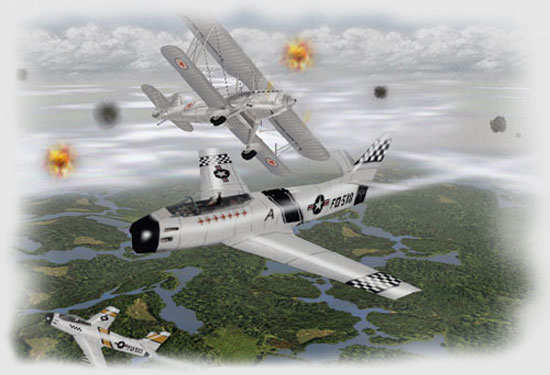
“More mods!” the EAW Community cried. They wanted entirely new aircraft beyond the game’s 20-standard aircraft limit. 1942: Pacific Air War (PAW) designs were remodeled. “Charles” was a leader here. Thanks to specialized software created by Allesandro Borges and more recently by “Gurney” new aircraft and game “objects” are possible. Whole new “scenarios” appeared to fly and fight from Russia to Africa to the Pacific theatres — and beyond. Mars Air War was created by “Von Beerhofen” (Roel Bartels) to fly for fun. EAW Secrets of the Luftwaffe honors the older game.
Original 1998 system requirements (still in effect )
- 166 megahertz Pentium, equal or better.
- 133 megahertz with a “3D graphics acceleration card”
- CD-ROM drive
- 32 megabytes of RAM memory
- DirectX 6.0 (on the install CD)
- Glide API version 2.43 or higher to use 3Dfx Glide support
- Hard Drive space – 2-megabyte minimum to play off CD
– 55 megabyte “typical” install
– 552 megabyte full install - 28.8 bps modem for online multiplayer games
- Windows 95 or 98
Current recommended system
- 1.2 Patch (released in 1999)
- 333 mhz or faster computer. Newer “high-resolution” graphics make this desirable, but not mandatory. Users still report happy results from older machines.
- A decent graphics card of your choice – except ATI, which lacks horizon “fog” and a briefing screen display in EAW. Usable without these advantages.
- Old cards usually work fine even at low megabytes of video memory. Caution suggests 32 megs of video memory. New, expensive cards don’t always work well even with DirectX 9.0. Older drivers sometimes help. Problems are signaled by a “7217” error notice.
- Patches, special .exe files and changes are available to obtain horizon “fog” and correct briefing screen corruption and other troublesome graphics problems with Voodoo and Glide, but results vary.
- Full 552 megabyte install recommended for best game speed, with user community “patch” to play without CD if you choose.
- 64 Megs RAM memory. More is always considered better, but no one is sure if it makes much difference.
- DirectX can be upgraded to 9.0 Opinions vary on upgrading, but 9.0 is said to be compatible with older DirectX versions.
- Hard drive – As many gigabytes as you can afford. Not for the game. For all the “mods” available (about 1 gigabyte worth).
- Windows 2000 – A patch is available to run EAW on Win2k. Can be found at “Tally-Ho”, the main EAW library site.
Windows XP may run EAW perfectly or give problems, depending on machine and programs installed. The Win2k patch may work for XP. All .exe files must be renamed to “eaw.exe” (done automatically by one new user-created program, OAW). XP requires a minimum of 256 megabytes of RAM memory, most of it for its own use.
Windows 98 SE (second edition) is still the standard for most trouble-free EAW play.
Modems? Some still use them in this day of broadband — at 56k maximum speed. Online play restriction to eight players and not being able to join a game in progress still dominate the yells for improvement to the “.exe”
Related Posts:
Related posts:
 EAW: New Life for an Old Flight Simulator
 Page 10
EAW: New Life for an Old Flight Simulator Page 2
EAW: New Life for an Old Flight Simulator Page 5
EAW: New Life for an Old Flight Simulator Page 6
EAW: New Life for an Old Flight Simulator Page 7
EAW: New Life for an Old Flight Simulator Page 8
EAW: New Life for an Old Flight Simulator Page 9
EAW: New Life for an Old Flight Simulator
EAW: New Life for an Old Flight Simulator Page 10
EAW: New Life for an Old Flight Simulator Page 2
EAW: New Life for an Old Flight Simulator Page 5
EAW: New Life for an Old Flight Simulator Page 6
EAW: New Life for an Old Flight Simulator Page 7
EAW: New Life for an Old Flight Simulator Page 8
EAW: New Life for an Old Flight Simulator Page 9