A SimHQ “Second Look” Series Feature
By Guest Writers Joe Keefe and Fredi “Bones” Dangoy
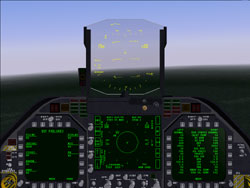
If you are a fan of naval aviation and flight sims, you have no doubt taken a look at Jane’s F/A-18. Created as a further development of the Jane’s F-15 engine, Jane’s F/A-18 was released in early 2000 and received good reviews even on popular gaming Websites (8.8/10 on Gamespot and 93/100 on Gamespy). In the flight sim community Jane’s F/A-18 is credited for its immersive gameplay, fantastic air-to-air radar modeling, avionics fidelity, and carrier ops. Almost 6 years after its release, the SimHQ Jane’s F/A-18 Forum is still active, and the archives contain an unprecedented wealth of information specific to the employment of Jane’s F/A-18 weapons and tactics.
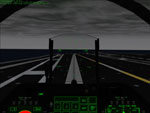
Jane’s F/A-18 was developed by the same team that created Jane’s F-15, and the similarities between the two are obvious. Jane’s F/A-18 also built on the momentum of the “Jane’s” name, following in the footsteps of the US Navy Fighters series (including Fighter Anthology), Longbow and Longbow 2, and Israeli Air Force. But Jane’s F/A-18 gave sim pilots something that had never been done before: full Case 3 carrier operations, complete with meatball (IFLOLS), LSO, pitching and rolling deck, variable weather, a marshal stack, and an approach controller. No long runways here, just a nice tennis-court-sized landing area with four 2-inch thick steel cables separating a safe trap from a dip in the ocean. All carrier aircraft participate in the launch and recovery, and they’re not perfect, either; their hooks skip, they bolter, and they get waved off, just as in real life.
The world is full of aircraft, ranging from other F/A-18E Superhornets to F/A-18Cs, F-14Ds, S-3Bs, E-2Cs, and SH-60s. Comms chatter is abundant, and at times confusing; aircraft call airborne, report their travel outbound, and communicate with the marshal controller to recover back aboard the boat.
 |
 |
 |
 |
 |
 |
Many Jane’s F/A-18 pilots say that their most tense experiences with the sim do not come from any sort of combat; they come from a hairy landing, usually single-engine on a pitch black night, low on fuel when the pattern in full. Here is an account by “Blitz_25th”, posted in the Jane’s F/A-18 Forum in March 2001. There are a few “famous” posts in that forum, and this is one of them:
I sustained some damage on one of my sorties; at first it was nothing big, but when I was around 50nm from Mother I got a Left and Right BLEED AIR warning. I immediately checked the BIT and ENG MDIs and found out that engine stats were OK, other than the increasing temperature.
I shut down the left engine immediately and reduced the right to 70% throttle. Then I checked my fuel state, jettisoned all stores, and declared an emergency. ATC told me to divert to an airbase located 110nm away, so I knew my only chance was to land on the carrier.
When my right engine EGT reached 1400 degrees, I restarted the left engine and shut down the right engine. As I headed inbound I repeated this procedure 2 times, trading the hot engine for a cooler one. 10nm from Mother I got an OIL PRESS warning on the right engine that had just been restarted, so I had to restart the left engine as well. Now I was running on both engines, and neither of them was doing very well; the left engine was hot because it had just been shut down, and the right was hot because it was running out of oil. My plan was to gain as much air speed and altitude as I could before I shut down the right engine.
Around 5nm from the carrier my right engine caught fire before I could shut it down; I used the extinguisher, and wound up at angels 6, 200 knots, single engine. This engine was rapidly moving into the Fire temperature zone. Around 2.5 nm from Mother the EGT reached 1500 degrees and I knew I had very little time left.
I pulled the power to idle and glided to the carrier. As my speed decreased rapidly, I went dangerously low on the glideslope and I knew I was risking a ramp strike, so I had to apply some power to correct. I knew it was a matter of seconds before my left engine caught fire, and I just hoped it was not before I trapped. I caught a 2 wire successfully and shut down the engine immediately.
Exciting, isn’t it? As you can tell from the account above, Jane’s F/A-18 models cascading damage; damage you take over the target might not immediately bring you down, but over time fuel leaks, oil leaks, engine failure, and even loss of cockpit oxygen can make your life miserable. Cascading damage is also affected by the stress you put on the damaged components; a damaged engine is much more likely to stay in one piece if you egress gently at 50% throttle than if you kick in the ‘burner and pull 6 Gs in your attempt to run away quickly.
 |
 |
Related Posts:
Related posts:
 Jane’s F/A-18 Simulator Revisited Page 2
Jane’s F/A-18 Simulator Revisited Page 3
Jane’s F/A-18 Simulator Revisited Page 5
Jane’s F/A-18 Simulator Revisited Page 6
Jane’s F/A-18 Simulator Revisited Page 7
Jane’s F/A-18 Simulator Revisited Page 8
Jane’s F/A-18 Simulator Revisited Page 9
Jane’s F/A-18 Simulator Revisited Page 2
Jane’s F/A-18 Simulator Revisited Page 3
Jane’s F/A-18 Simulator Revisited Page 5
Jane’s F/A-18 Simulator Revisited Page 6
Jane’s F/A-18 Simulator Revisited Page 7
Jane’s F/A-18 Simulator Revisited Page 8
Jane’s F/A-18 Simulator Revisited Page 9
 Operation Flashpoint, Revisited Page 2