System Requirements
Once you have the files you want, installation is painless and consists of merely unzipping the files into a directory you build on your hard drive. Before you plop Orbiter in your system, think of this: it is a modern sim that has modern system requirements. The requirements include:
- 300 MHz PC or better (Pentium, Athlon, etc.)
- 128MB RAM or more
- Windows 95 / 98 / ME / 2000/XP
- DirectX 7.0 or higher
- DirectX compatible 3D graphics accelerator card with at least 16MB of video RAM (32MB or more recommended) and DXT texture compression support.
- Approximately 60MB of free disk space for the minimum installation (additional high-resolution textures and add-ons will require more space).
- DirectX compatible joystick (optional)
These aren’t bone-crushing for the average simaholic, and most of our readers have more machine than they need. Keep in mind that the more add-ons you have installed, the more system you’ll need. I run an Athlon 3000XP with an NVIDIA 6800GT AGP processor and I get crunched even with a full gig of RAM when I have all the highest-poly-count add-ons you can get installed. High textures cause problems, and that’s true of most any sim. Dr. Schweiger has included visual effects such as cloud layers, lens flare, specular lighting, night lights, shadows from objects, all kinds of things. It’s not IL-2 or Lock On version 1.11, but it isn’t bad and in my opinion, is about equivalent to a 2001-2002 simulation release and nearly as good as Microsoft’s Flight Simulator 2004 in base trim.
Real-World Physics and Orbital Mechanics
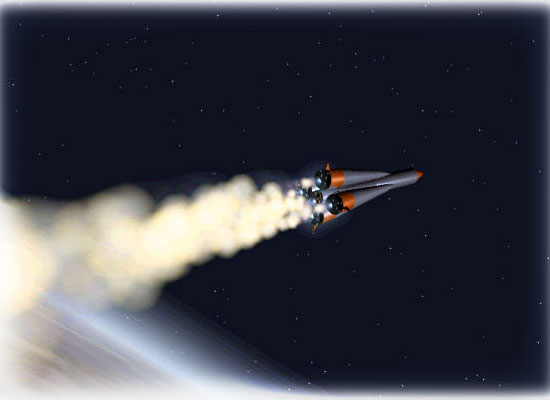
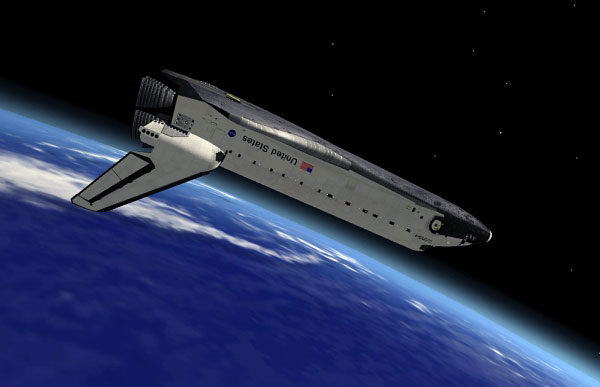
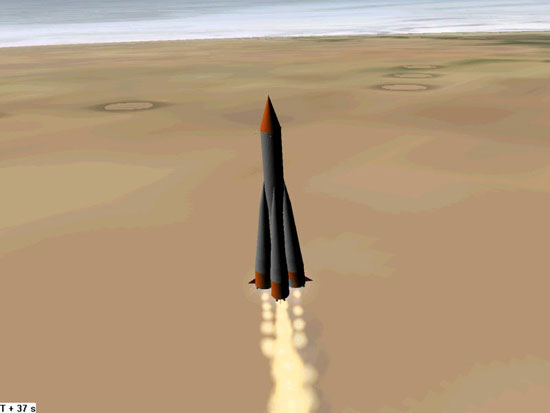
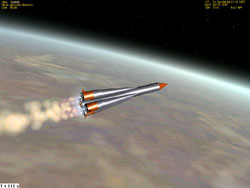
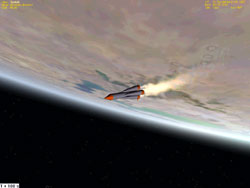
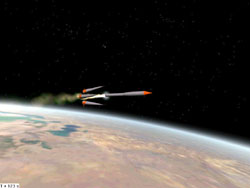
Dr. Schwieger’s biggest achievement is the use of real-world physics and orbital mechanics in Orbiter’s design. This sim isn’t about eye candy. It is about flying. And not just flying, but flying from planet to planet. So far, Orbiter hasn’t achieved interstellar flight, but users have built whole new star systems to take Sol’s place, for those folk who want that sci-fi experience. Orbiter comes with the entire Sol system installed other than Pluto, though the planets aren’t as pretty as Earth is. You can get high-res textures of almost all the other planets, however, from the abundant mod community. In its base trim, you can fly any one of four fantasy spacecraft that allow you to take off and fly to the International Space Station, Mir, or the Moon, or one of the other planets. In addition, Orbiter’s base package includes a very good representation of the Space Shuttle Atlantis and the Hubble Space Telescope, for those of you who want to recreate those missions.
Orbiter is rather complex. As I said, this sim is about flying, and that means flying from the perspective of the spacecraft. You can use a joystick if you have one, or fly from the keyboard. Dr. Schweiger has modeled a powerful and detailed autopilot that is a real help in doing things like pointing your tail toward your direction of flight (retrograde attitude) for firing retros and dropping out of orbit, or the opposite for when you’re trying to leave orbit. The four fantasy spacecraft have at least rudimentary cockpits, some of them virtual cockpits. In some cases, the add-ons have very exquisitely detailed cockpits, but what is most helpful are the included multifunction displays that Dr. Schweiger and the talented mod community have added. These allow all sorts of interactions with your flight. You can display a map of the planet you’re orbiting, calculate orbit and transfer orbits, intercept orbiting bodies like space stations, escape from your current orbit, all sorts of things. You also have several head-up display modes that show you symbology for atmospheric flight, close orbit, and docking maneuvers. OrbiterSound, when you find and install it, allows you to use a Winamp playlist to add your own soundtrack in the form of .mp3 files, and many of the add-ons have extensive sound libraries.
 |
 |
 |
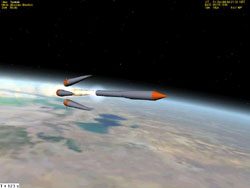 |
Dr. Schweiger uses Newtonian physics and accurately recreates gravitation and planetary effects. He’s also modeled the orbits of all eight of the included planets relative to one another, and in the expansive .pdf manual you can see some of those, as well as a lot of the very esoteric mathematics involved for orbital flights. He also has modeled the interface between atmosphere and space accurately, and you can do dumb things like goof a reentry and bounce off the planet’s atmosphere. This is the only space sim I’ve seen where the transition from atmosphere to free space is seamless, and I wish we saw that in games like Starshatter, that are excellent space combat games.
Orbiter would be interesting as an underlying engine in a combat sim, plotting a battle in a real gravity well around a planet. That’s one of the things that irritated me about Starshatter, by the way, that the nearby planets didn’t influence the larger spacecraft. It would be greatly like a battle between sailing ships, as you laboriously calculated your orbit to match the enemy’s and engage him, and watching for hours as you closed on your prey… because of the vast distances involved.
You could do maneuvers that took into account the various celestial bodies and their gravity, as Orbiter allows you to do wild things like plot slingshot orbits like the ones used by the Voyager 1 and 2, and Pioneer 10 and 11 to reach the far distant parts of our solar system. You could get old watching this go on. But that is why we have time skip functions, right? And herein lies Orbiter’s one glaring weakness that I’ve found. Its timeskip function will goof up its real-time physics and if you use it to accelerate time too fast, your interplanetary flight will turn into a tumbling, pitching mess. This is a known problem, and Orbiter diehards will counsel you to use time acceleration functions carefully, sparingly, and only on very long-distance flights when you’re not in proximity to a planetary gravity source. The bottom line: Be prepared for a steep learning curve when you fly Orbiter. It is not for the sim novice, and there is no arcade mode.