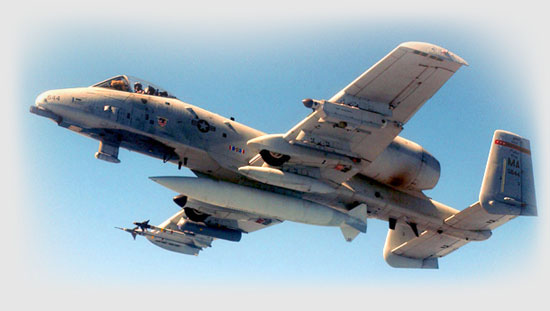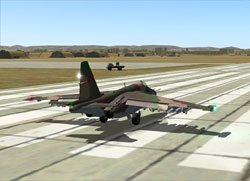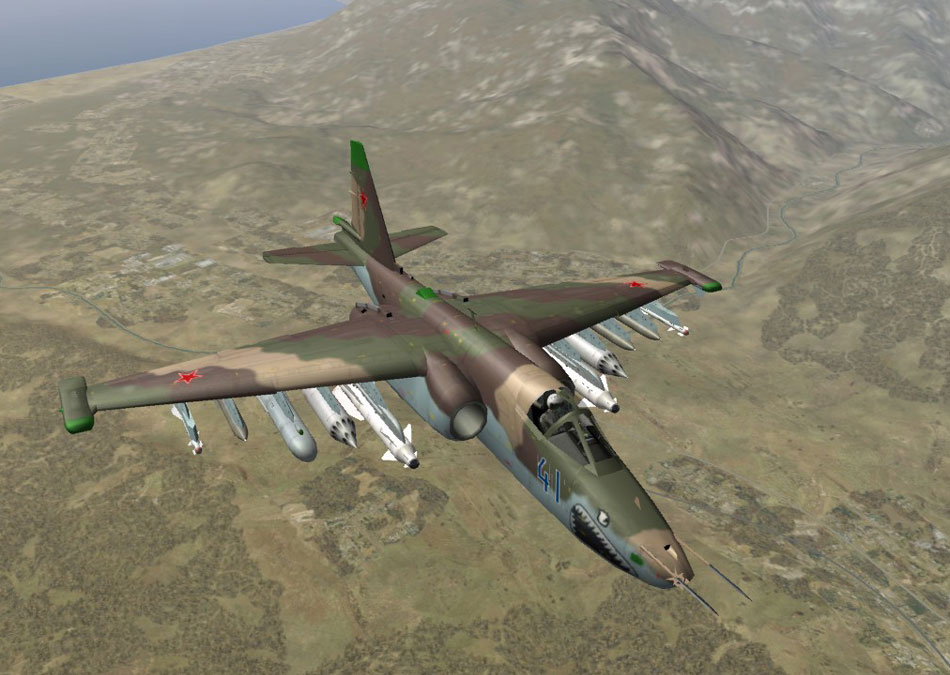

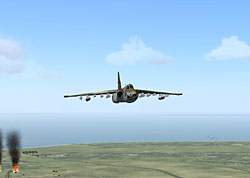
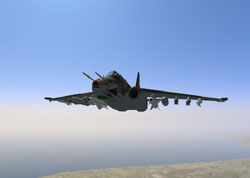
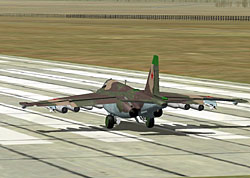
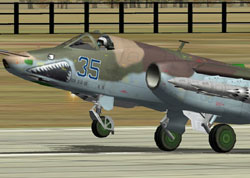
The chief of the VVS laid down the actual specification for the USSR’s new Sturmovik. This was a project of great importance, and some of the Sukhoi OKB’s most famed designers collaborated on the T-8, the aircraft that would become the Rook. Among them were Oleg Samolovich, the designer of the Su-27. Interestingly, Vladimir Ilyushin, the son of the man who designed the original Sturmovik of World War II fame, piloted the first flight of the T-8, in 1975. The Sukhoi team ultimately built their design around two proven engines, the Tumanskiy RD-95Sh, an engine that in afterburning form was used on the MiG-21 fighter. This was probably the best jet engine in series production in the mid-1970s in Russia, and is known to be a multi-fuel unit that can even burn No. 2 Diesel where needed. Rugged and reliable, it has plenty of power and soldiers on to this day in the current Russian air force. This aircraft is designed to operate from unprepared, mud landing strips; in fact, it is known to be able to taxi in places that 6×6 trucks have become stuck. An innovative feature allows Rook squadrons to deploy totally self-contained — they can carry maintenance supplies in underwing pods to allow setup anywhere the pilots can land, assuming their support personnel can get into the makeshift airfield. Another feature of the Rook, one it shares with the American A-10, is the provision of special protection for the pilot. Su-25 pilots are enclosed in a thick titanium “bathtub” 10 to 24 mm thick in spots, and they peer out at the world through armored glass. Tests have shown the Rook’s cockpit proof against 20mm and 23mm cannon fire. The pilot sits atop the Severin K-36L ejection seat, identical to that used in the MiG-29 and Su-27 fighters. The aircraft has three self-sealing fuel tanks, but like most Russian combat aircraft cannot engage in air refueling, and is cursed with relatively short range when compared to Western contemporaries. The Rook can carry a startling payload for such a small aircraft, sporting eight hardpoints for all manner of ordnance. It also has two more dedicated stations, located the outermost of each wing, on which it can pack IR missiles, either R-60 or in later variants, R-73, for defense against helicopters or fighter aircraft. Rooks can carry all non-guided bombs 500kg and under in Russian inventories, as well as Kh-25L, Kh-29L, and S-25L laser-guided missiles. Su-25 squadrons are also known to have used twin-barrelled 23mm cannon pods in clusters of up to four per aircraft, and the Su-25 is type-rated for UB-13, B-8, S-24, and S-25 unguided rockets. It carries an internal 30mm cannon, alternately designated AO-17 and GSh-30-2, with provision for 250 rounds, replacing the initial twin-barelled 23mm cannon carried by the first T-8 prototype. The 23mm weapon was similar to that used in the gunpods, and it was also found on contemporary aircraft such as the MiG-21PFM, in the external gun-pod. The 30mm cannon carries nearly the same number of rounds, and has more hitting power per round.
 |
 |
 |
 |
 |
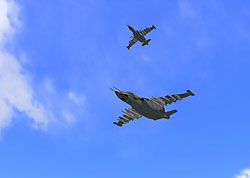 |
Avionics include a nose-mounted Klen-PS laser rangefinder for accurate targeting of Kh-29L, Kh-25L, and S-25L laser-guided missiles, as well as providing target information for unguided rockets and bombs. The Klen is the same attack system used on the MiG-27 ground-attack variant of the MiG-23 interceptor. In addition, the Su-25 can carry laser-guided bombs, and although like the MiG-27 it cannot designate on its own for such a weapon, using the Klen one Rook can buddy-lase a ground target for another. Rooks operate in pairs in Russian doctrine, and reports from Afghanistan in the mid-1980s indicate those Su-25 squadrons sometimes used KAB series laser-guided bombs. The head-up display is old-fashioned, and does not provide information other than aircraft bank angle. It projects an aiming reticle that shows a range scale, and warns the pilot of launch consent and laser lock via lights, a very old-fashioned approach. Targeting is clumsy, the pilot using her reticle to visually lock the target and lase it, and thus having a very limited cone of view for the laser. The Klen can operate for one minute, and then automatically shuts off to cool before it can be used again. The pilot can override this, but runs the risk of burning out the laser if she does.
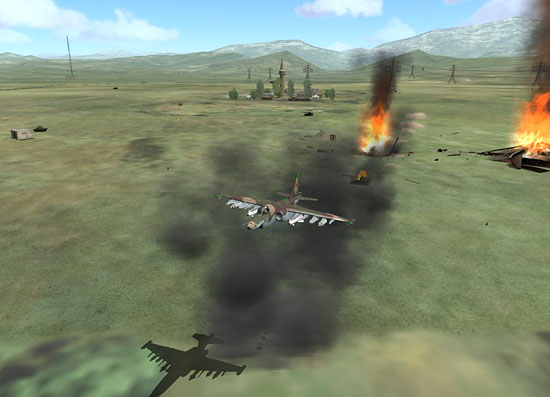

Rooks also sport the SPO-15 “Beryoza” radar-warning system, the same as that used in the MIL-24 and 28 helicopters and MiG-29/Su-27 combat aircraft. Rooks have a Doppler system for radar altitude, and carry current IFF systems. They also have a full suite of communications gear, including something lacking in American forces other than the U.S. Marine Corps: ability to directly communicate with ground troops. The navigation system is adapted from that used in the Su-17 ground-attack aircraft, and the Rook can carry the SPS-141 jammer pod on its right wing — an item used with great effect against contemporary American radars operated by the Iranians in the Iran-Iraq War. The aircraft carries both chaff and flare dispensers, a total of 256 combination cartridges similar to those deployed on the Su-27 interceptor. Rook squadrons experienced trouble from late Strela and U.S. Stinger missiles in Afghanistan; the countermeasures and armoring had been designed very effectively against the early U.S. Redeye, but later IR MANPAD SAMs were responsible for downing several of the 23 Rooks known to have been lost in combat in that conflict. One thing added because of the MANPAD threat was a pilot-activated fire extinguisher system.