Let’s take a look.
I of the Enemy’s installation and gameplay is pretty straightforward. You’ll need only the most basic of machines to run it, as it is Win95, 98, Me, 2000, and XP compatible. You’ll need 128 MB of RAM, at least 25 MB of free drive space (depending on the type of installation you choose), a 4x DVD/CD ROM drive or faster, and DirectX 8 or higher. The full install, including the separately-downloaded-and-installed tutorials, ran me 136 megabytes, which is tiny in this day and age. After you install it on your PC, you can run through several well-crafted training sessions. They are not interactive, but they do show the game-engine in action and the voiceovers show you how to control your on-board units. You’ll need these, because I of the Enemy: Ril’Cerat has no manual! Fortunately, the game interface is easy to understand and even the lowest neophyte will be able to pick it up in short order.
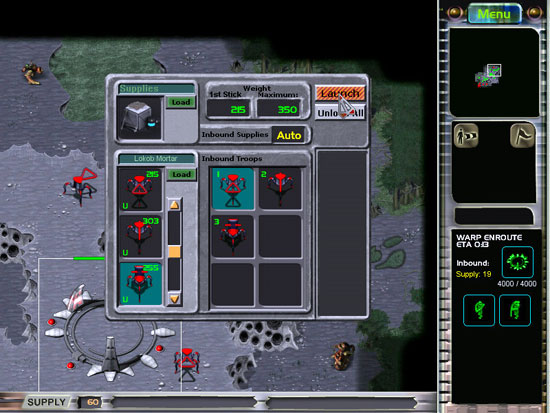
Each mission begins with a voiceover briefing from the Lokob high command that is at least partially in primitive CGI, with the presentation being akin to a teleconference with the other Alliance military leaders. Here is where I of the Enemy presents its tactical situation and tells the game back-story. It’s well done, especially for a hip-pocket independent studio like Enemy Technology. After the briefing, you are given the opportunity to transport your most experienced units into the current scenario. A click on the go-button, and you’re in game, looking at your mission objectives.
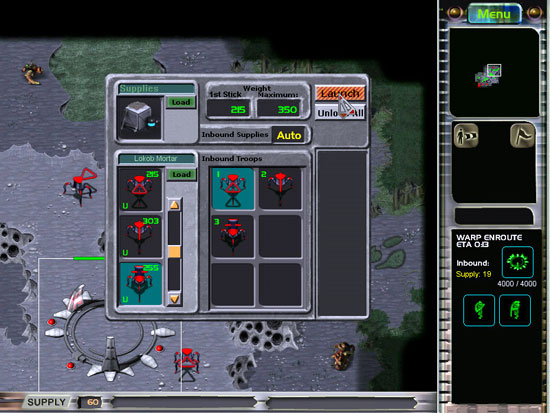
The presentation is top-down. You enter each mission with a jump-gate, and sapper units to construct new jump-gates and serve as antiaircraft guns. Protect your sappers, because they are all-important. You also have a number of supply points that build over time, as long as your jump-in gates are functional. You need supply points for your sappers to build new gates, and for your artillery units to have bullets to fire, and to land new units on-planet. Protect them. This is your landing-zone in each mission. The game itself is real-time, not turn-based, and things happen fast so you’ll need to be on your toes.
You have two types of Rag’ha infantry units, a Lokob cannon that is a sort of walking tank, your sapper, a mortar unit that can fire basically all over the map, the Y’dray fighter, and transport vehicles that function much like large helicopters. The units are individual, not a stand-in for large groups of units; this is a tactical-combat game. They each have their own personal names so you’ll get to know them, and as they gain experience in combat their capabilities improve. Mortars can throw more bombs; fighters become more powerful, cannon increase their rate of fire, infantry become harder to kill and get stronger weapons. The most important units on the map are irreplaceable: they are your field commanders, Colonel Verkkal and Captain Aedeck. If you get either one of them killed, you lose the scenario. They are both multidimensional, being able to shoot at fighters and ground equipment, and they have very powerful weapons.