
by Bubba “MasterFung” Wolford
 SimHQ: With war raging in the Middle East, many of us are thinking of our troops and fellow simmers involved in the war. We at SimHQ have several staff members involved in the conflict including our F/A-18EF back-seater “CHUNX”, Killer27 who is flying AH-64 Apaches and our favorite medic Tom Cofield who is serving the wounded in the Kuwaiti KTO. We have received letters asking how companies are involved with the troops while they are on extended stay in the war. Can you tell us how Intel is involved in the war effort and what weapon systems are powered by Intel based products?
George Alfs: Intel used to have a full military division, making military semiconductors to specific voltage, temperature, and reliability specifications. However the military has found “off-the-shelf” parts to often be quite sufficient for their needs due to the tough reliability specs that are part of our everyday manufacturing. Most military purchases are done through distributors these days, so we don’t have good visibility into their purchase needs. I would talk to some experts in the military electronics field.
The military has been spending millions of dollars on simulators each fiscal year to ensure that our pilots and troops have the absolute best training possible. These elaborate simulators offer the best the VisSim community can build. Can you describe how Intel’s new Canterwood chipset will provide increased performance and realism to today’s PC’s?
In a word — bandwidth. Processors and other key components in the system are getting to be very high performance, and the infrastructure around that processor needs to get it data fast, so that we can move to the next level of applications and graphics. The Intel 875P chipset features support for an 800 MHz system bus and implements Intel Performance Acceleration Technology (PAT) with dual-channel DDR400 memory configurations to get incredible performance from the memory interface. Optimized to support the Intel Pentium 4 Processor with HT Technology, the 875P chipset adds intelligence to help manage and prioritize multiple threads received from the microprocessor.
The 875P chipset-based platform integrates Intel Communication Streaming Architecture (CSA) featuring a Dedicated Networking Bus interface, Hi-Speed USB 2.0, integrated Serial ATA and RAID, all of these can improve the computing experience in tangible ways.
Can you describe how Intel’s Hyper-Threading Technology is being received in the development community and what upcoming software packages and games plan to take advantage of Hyper-Threading?
 HT Technology is a wonderful technology because it takes advantage of existing infrastructure — threaded applications and multitasking environments. Before we brought HT Technology to the mainstream, we worked with Microsoft to fully incorporate support for it in both versions of Windows XP, both Pro and Home. With OS support, and support in DirectX, Windows Media Player/Encoder, and other key software infrastructure, HT Technology had instant software support when we launched our 3.06GHz processor. Even running two non-threaded applications simultaneously can show performance benefits. As more applications are threaded for performance benefits, you will see your existing HT Technology enabled processors take more and more advantage of this software trend. We already see good performance advantages in photo imaging, video and audio encoding software. Games historically have not been threaded for performance, but I’ve seen your data on Falcon 4.0, and upcoming games include Dreamwork’s Sinbad, Lego Bionicles, and Legendary Adventures, and more.
How much more efficiency can Intel squeeze out of Hyper-Threading Technology? We will ever see Hyper-Threading Technology based PC’s replacing dual processor based PC’s?
I don’t think a Hyper-Threaded processor compares to having two separate, individual processors. On a well optimized threaded piece of code, where the second processor boosts performance by say 70%, a second virtual processor might get you say 25%. These are significant performance boosts in any case, and as more apps get threaded, everyone benefits. As we see dual core processors later this decade, the performance gains will be significant and HT Technology has helped get the mainstream software environment ready for that.
Can you describe Intel’s current position as it relates to the use of RDRAM? Will Intel continue to support and promote RDRAM or is Intel moving toward total adoption of DDR?
We continue to ship our 850E chipsets, which supports RDRAM. As well some of our networking products support RDRAM. However the industry as a whole is moving towards DDR and later DDRII memory for PC memory, so our latest 875P and Springdale chipsets will support DDR, more specifically dual channel DDR400 memory for highest performance. DDR seems to be cheaper at the moment, and is more widely available. We don’t have another chipset supporting RDRAM planned at this time.
Would you mind talking about where the Pentium 4 processor is heading over the next 2 years? How many more iterations of the Pentium 4 will we see and at what point will Intel move on to the next generation Pentium?
 We will continue to boost Pentium 4 processor speeds this year. However we have a lot of focus on our Prescott processor, which we will launch later this year. Prescott branding has not been determined, but it will launch at over 3 GHz, and we see that as the short term vehicle to continue to boost performance, not just by increasing MHz, which we will, but by increasing cache sizes, more instructions, etc.
How will Intel continue to increase processor speed to keep the power curve going? How much smaller can die size get?
Increasing MHz is just one way to increase performance, per my answer above. The Pentium 4 processor was a radical architecture design, and folks wondered. But in the age old “speed demon” vs. braniac” CPU architecture debate, going the speed demon route has often been found to be the right way to deliver performance to end users. But you need to supplement MHz increases with other improvements, such as wider bandwidth in the chipset, larger caches, instruction innovation, etc. As far as die sizes, our roadmap clearly has us going to 90 nanometer this year, then 65 nanometer and beyond. We don’t see the end yet, even as we delve into the atomic level.
Intel has been spending lots of money in advertising talking about multimedia and the digital experience. Can you talk about where you think the digital experience is going and the efforts Intel is making to bring PCs closer into our lives?
I don’t think anyone argues that the consumer and office worlds are going more and more digital. When was the last time you used your fax machine? Ever since I bought a digital camera, the 35mm has been gathering dust. Can you imagine a world without email? Or your computer? I’m asking these questions fairly confidently since your readership is definitely computer literate. Certainly there are many folks where computing has not touched their lives as much as your readership but that is more opportunity for Intel. Intel, using our research labs will continue to explore new uses for computers and other digital devices. For example, think of the aging population and how we care for them. Going to a nursing home is not what a lot of folks look forward to. What if they could stay at home and their children could monitor them electronically — automatically reminding them to take medication, etc. This is just one area our labs are looking into.
How does Intel plan to counter AMD’s new Hammer line of processors? Can you talk about Intel’s plans for 64-bit processing at the home/workstation desktop?
 Competition is a good thing and nothing new for us. We’ll continue to do what we always do, bringing value to both consumers and IT. IT needs more than a server CPU, they need the software infrastructure, chipsets, tools, reliability, manageability, and support that come with servicing a server environment. Intel has been working with IT for years now and we continue to have the right solutions for them.
Part of that is providing benefits, not marketing. There are definite advantages to 64-bits in the backend server environment, and Itanium2 has its third generation coming up and there are a variety of Linux and Microsoft and Linux OS’s, applications, and tools that support it now. For workstations and home PCs, HT Technology, fast busses, integrated SerialATA, high speed USB 2.0, etc provide real benefits today. The 64-bit infrastructure is not here today and is not “for free”. A lot of work is ahead of the industry on that, down to the driver level.
Many wonder why AMD’s line of processors are theoretically so much slower when comparing processor speed (MHz) yet are able to get so much more performance clock for clock. We know what AMD’s views are but how does Intel explain the disparity?
As I mentioned, in the age old “speed demon” vs. “braniac” CPU architecture debate, going the speed demon route has often been found to be the right way to deliver the highest performance to end users. And I think the industry now realizes why we lengthened our CPU pipeline to go that way. Our competition says MHz doesn’t matter. Do you think they really feel that way? I think it is one of the basic elements of the equation we all agree on: MHz x IPC = performance. Architects have always balanced IPC vs. clock speed, to determine which way to get higher performance. If you make a clock for clock comparison, you are subtracting some of the architectural decisions we made from the equation. What matters to end-users is delivered performance, which is one of the places we excel.
Can you explain what PAT means to all of us non-technical people? “How does this help my computer go faster”? is the most common question.
Performance Acceleration Technology is one of the features of our 875P (Canterwood) chipset. We basically bin our Memory Controller Hub (MCH) chips like our CPUs, finding the fastest silicon. We can then use this fast silicon to shave off a couple of memory clock cycles, resulting in better performance.
Finally, what is Intel’s strategy to combat AMD’s move to Opteron? Initial benchmarks show that a ~2GHz Opteron might up stage a 3GHz Pentium 4 on some popular benchmarks. Do you think Operton is AMD’s last hope?
Bubba, you are comparing a server processor vs. a desktop processor. It sounds like you are comparing a processor core with a 1MB L2 cache vs. a desktop processor with a 512MB L2. I guess it is in the eye of the beholder. I’m quite satisfied that our currently shipping products outperform silicon that isn’t in production yet on the desktop. And we don’t even have to use the die space for a 1 MB L2 to do so. And that relates to one thing you didn’t ask about, our manufacturing capabilities. As far as what AMD is hoping for, you should ask them.
Thank you Mr. Alfs. It is always a pleasure to speak with you and we really appreciate you taking time from your busy schedule to answer these questions for our readers.
Thanks Bubba.
Related posts:
 AMD Athlon™ 64 X2 3800+
 Core™ 2 the Extreme: Intel Retakes the Field
 Dueling Dual Cores: AMD vs. Intel
 Intel Dual-Core Pentium Performance
 Page 4
Intel Dual-Core Pentium Performance
Intel Dual-Core Pentium Performance Page 4
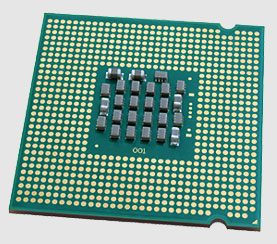 Intel P4P 660 and 3.73 Extreme Edition
 Intel Pentium 4 670 3.8GHz
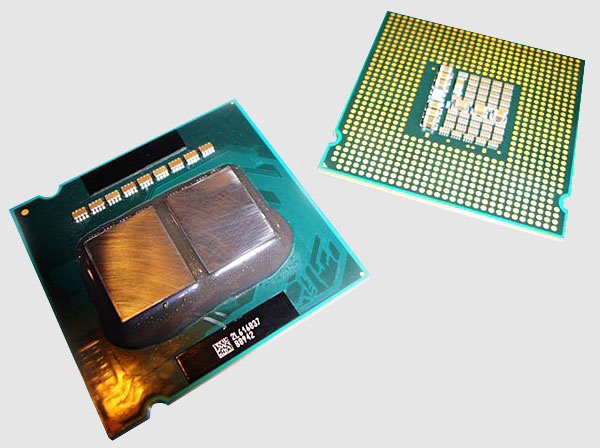 Intel’s Core™ 2 Extreme QX9770 Performance Preview Page 6