by John Reynolds
Pins and Latency
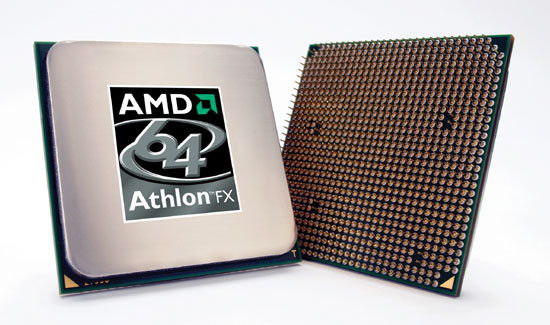
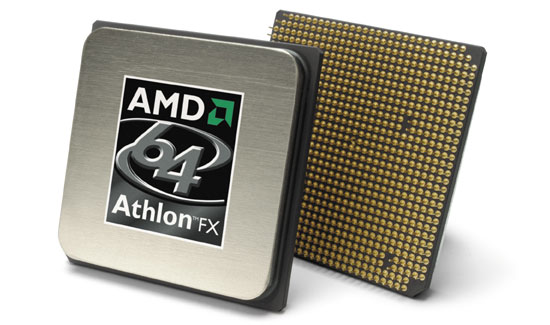
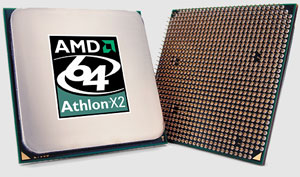
 AMD launched their AMD64 platform last year, introducing 64-bit instruction and addressing first to the business server market with the Opteron processor and subsequently to the consumer desktop market with the Athlon 64 FX and Athlon 64 processors. These new CPUs quickly garnered gaming enthusiasts’ attention as they demonstrated performance superior to that of the competition’s processors in many important benchmarks. This appreciable performance, combined with the promise of future potential when used with 64-bit software, seemed to pave the way for this new platform. Yet AMD knew that the requirement of using registered memory for the early Athlon FX and 64 processors — essentially rebranded Opterons — wasn’t a strong selling point for the consumer market. Thus the introduction of a new interface with support for conventional, unbuffered DDR memory, Socket 939.
AMD launched Socket 939 and its new Athlon 64 FX and Athlon 64 processors on June 1st. This new 939-pin lineup consists of one FX CPU, the FX-53, which, similar to its 940-pin sibling, is clocked at 2.4 GHz, sports 128 kb (64K data / 64K instruction) of L1 and 1 MB of L2 cache, and is comprised of roughly 106 million transistors. In addition to this FX-53, AMD has also introduced the Athlon 64 3500+ and 3800+ 939-pin CPUs, clocked at 2.2 GHz and 2.4 GHz respectively. Both Athlon 64s have 128 kb of L1 and 512 kb of L2 cache and approximately 68 million transistors. And like the Athlon 64 FX, the 3500+ and 3800+ are manufactured on a 130nm, SOI (Silicon on Insulator) process and boast a 128-bit, dual-channel, integrated memory interface that, combined with the new Socket 939 interface, now supports unbuffered PC3200 DDR memory, thereby removing the associated latencies of registered memory for better performance.
Last, AMD also introduced the Athlon 64 3700+ processor which uses the Socket 754 interface and is also clocked at 2.4 GHz Unlike the other new Athlon 64s, the 3700+ boasts 1 MB of L2 cache and a 64-bit memory controller. Industry analysts are predicting that the Socket 754 interface will be AMD’s mainstream approach since the 3700+ is a speed hike of the Athlon 64 3400+, but time will tell.
The AMD Athlon™ 64 Processor
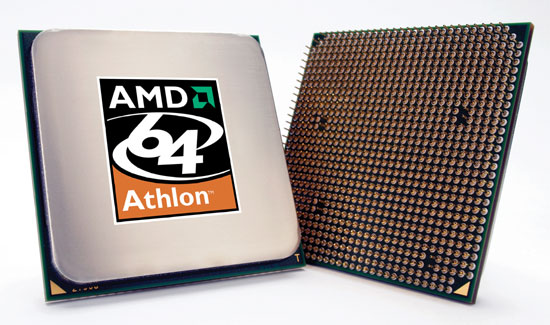
The AMD Athlon™ 64 FX Processor