Features and Pricing
The Socket 939 platform has several notable features, first of which is an increased HyperTransport link, which now runs at 1 GHz compared to its previous speed of 800 MHz. HyperTransport is essentially a bus that links to various I/O channels, such as the PCI bus, via tunnels comprised of differential signaling. Only 16-bits wide, though double-pumped, this bus requires high speeds to achieve its performance, thus the speed bump to 1 GHz and its 8 GB of system bandwidth (combined with the additional 6.4 GB via the CPU’s memory controller for a total of 14.4 GB) should give increased performance.
Next is AMD’s EVP, or Enhanced Virus Protection. Also known as NX (no execute) Bit, EVP is hardware support designed to prevent the execution of viruses on AMD64-based systems. Though it won’t be enabled until Windows XP’s SP2 (service pack 2) becomes available, EVP works by essentially halting the execution of code that’s attempting to run in a memory area marked as a data page (a common tool of virus writers). AMD are obviously heavily promoting this feature as one that could save corporations millions in associated IT costs. This reviewer, however, isn’t particularly eager to test the feature on his home computer <g>.
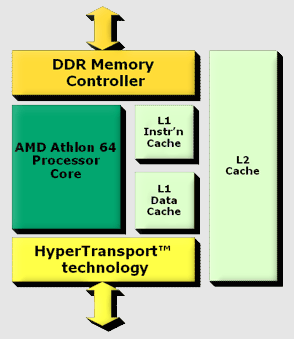
The AMD Athlon™ 64 Processor Architecture
Cool’n’Quiet is a technology AMD developed for their mobile platforms. The technology reduces both heat and noise by essentially downclocking the processor when when it is idling (i.e., running under a light load). Less heat is produced due to the throttled clock speed and less noise from slower fan rotation. This feature could be particularly useful for those with small form factor setups, such as Shuttle’s LANBOY cases.
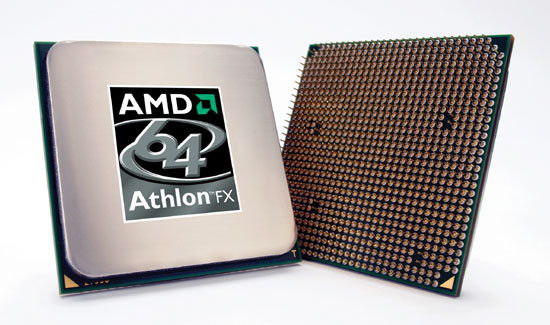
Last, prices on the June 1st launch for these new Athlon 64 processors were set as follows (in 1,000-unit quantities):
- AMD Athlon 64 FX-53 processor $799 each
- AMD Athlon 64 3800+ processor $720 each
- AMD Athlon 64 3700+ processor $710 each
- AMD Athlon 64 3500+ processor $500 each
Support for unbuffered DDR memory, however, will help lower the overall cost for building a Athlon 64-based system. A quick glimpse at current online numbers as of late June shows that the above price stickers have not moved much at all.
Test System Setup
- AMD Athlon 64 3800+ processor
- ASUS A8V 939 motherboard (BIOS 1003, VIA 4-in-1 4.51)
- 1 GB (2 x 512 MB) Corsair XMS PC3200 DDR RAM
- VisionTek 9800 Pro 128 MB (Catalyst v4.6 drivers)
- Adaptec 19160 SCSI controller
- 36 GB Seagate Cheetah 15,000 RPM HD (NTFS)
- Windows XP Professional (SP1)
- DirectX 9.0b
The benchmark suite that will be used to test the Athlon 64 3800+ is listed here. Again, unless specified otherwise all games are configured to use their highest settings, and 32-bit color and trilinear texture filtering are always used as the baseline default during testing. Also, Windows XP is configured to have Automatic Update, System Restore, and all unnecessary startup services disabled. Fraps v2.2.1 was used to record performance scores unless otherwise noted.