Test System Setup
- Intel Pentium 4 Extreme Edition 3.4 GHz
- Intel D925XCV motherboard (BIOS CV92510A.86A.0193)
- 1 GB (2×512 MB) Micron DDR2 533 MHz RAM (4-4-4-12)
- NVIDIA GeForce 6800 GT PCI Express graphics board (ForceWare 61.45)
- Maxtor MaXLine III (16 MB buffer) native SATA HD (2x) in a RAID 0 array (NTFS)
- Windows XP Professional (SP1)
- DirectX 9.0b
The benchmark suite that will be used to evaluate this test system is listed here. Again, unless specified otherwise all games are configured to their highest settings, and 32-bit color and trilinear texture filtering are the default baseline during testing. Also, Windows XP is configured to have Automatic Update, System Restore, and all unnecessary startup services disabled. Fraps 2.2.1 is used to record performance scores unless otherwise noted.
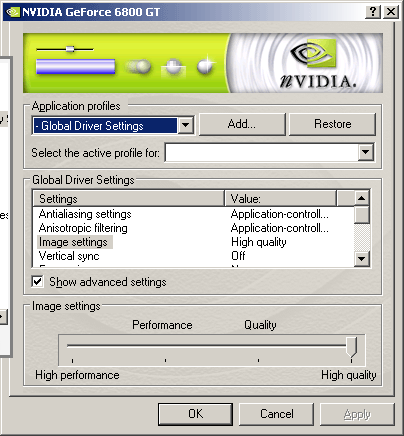
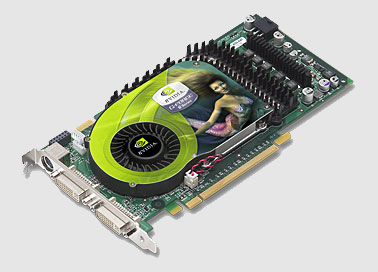
The GeForce 6800 GT being reviewed is a PCI Express board clocked at 350 MHz with 256 MB of 500 MHz (1 GHz effective) GDDR3 memory, which unlike the Ultra PCIe board is identical to the AGP 8x version. And being a PCIe design, the reference board has one 6-pin power connector rather than a 4-pin molex connector. The beta ForceWare 61.45s driver set — NVIDIA currently does not have WHQL drivers for the GeForce 6800 series — were used and manually configured for high quality settings, with both trilinear and anisotropic filtering optimizations disabled.
Also worth noting is that NVIDIA’s current PCI Express solutions are not native PCIe boards, instead making use of a HSI (high-speed interconnect) bridge chip to communicate between the graphics bus and the chip itself. Capable of realizing the full upstream bandwidth of the PCIe x16 bus, the HSI chip should not be the cause of any performance issues for those with PCI Express motherboards as current gaming software is simply not limited by the graphics bus (PCIe or AGP).
Related Posts:
Related posts:
 Gainward GeForce™ 6800 Ultra / 2100 Golden Sample
 Page 4
Gainward GeForce™ 6800 Ultra / 2100 Golden Sample
Gainward GeForce™ 6800 Ultra / 2100 Golden Sample Page 4
 NVIDIA® GeForce™ 6800 GT PCI Express
 Page 3
NVIDIA® GeForce™ 6800 GT PCI Express Page 4
NVIDIA® GeForce™ 6800 GT PCI Express Page 5
NVIDIA® GeForce™ 6800 GT PCI Express Page 6
NVIDIA® GeForce™ 6800 GT PCI Express Page 7
NVIDIA® GeForce™ 6800 GT PCI Express
NVIDIA® GeForce™ 6800 GT PCI Express Page 3
NVIDIA® GeForce™ 6800 GT PCI Express Page 4
NVIDIA® GeForce™ 6800 GT PCI Express Page 5
NVIDIA® GeForce™ 6800 GT PCI Express Page 6
NVIDIA® GeForce™ 6800 GT PCI Express Page 7