Image Quality
For years NVIDIA GPUs have been limited to an ordered-grid sampling pattern for their 4x anti-aliasing, which produced an inferior quality when dealing with polygon edges running along near-vertical or horizontal angles. Yet the 6800s now employ a rotated-grid pattern, which can be seen below:
4x AA Sampling Pattern
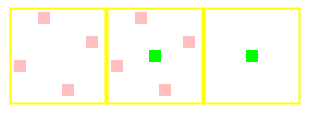
Unfortunately, due to a hardware ROP (render output) limitation, the 6800s can only perform a maximum of 4x multi-sampling AA. Yet the 6800 series also supports an 8xS anti-aliasing mode, which is a combination of multi- and super-sampling methods. The sampling pattern for the 8xS mode can be seen here:
8xS Sampling Pattern
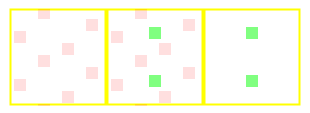
The GPU companies moved away from super-sampling several years ago due to its performance loss from rendering additional color data for each sub-sample. Yet one advantage of super-sampling is that the additional color data created would result in greatly reduced texture aliasing (e.g. texture shimmering); and as seen above, the 8xS mode writes color data into two rather than one of its sub-samples and this incurs a higher fill rate cost as shown by the additional IL-2: Sturmovik Forgotten Battles – Aces Expansion Pack testing below:
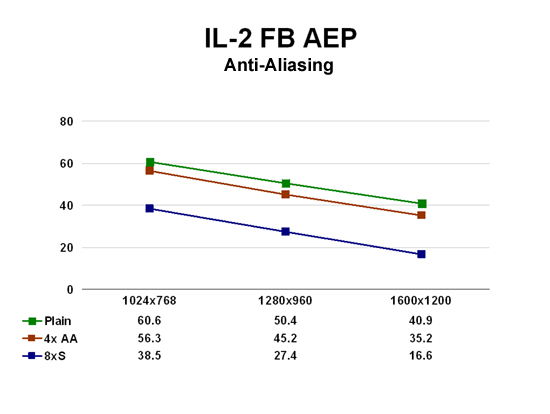
Whereas 4x multi-sampling dropped performance across the tested resolutions by roughly 10%, 8xS incurs a much higher frame rate loss, one that ranges from 40-50% depending upon the resolution. However, 8xS remains a viable mode at 1024×768 in newer titles, is particularly useful for many older games, and is generally worth enabling when possible due to the image quality improvements it provides. Note that all game screenshots throughout this review were taken at 1024×768 with 4x AA.
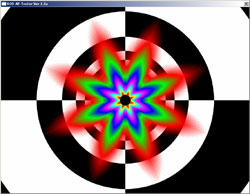
A theme throughout the benchmarking portion of this review has been the rather strong performance impact the 6800 GT’s anisotropic filtering had on certain games with the card’s filtering optimizations disabled. Using the Direct3D AF Tester utility to capture the images below, we can clearly see the differences the optimization settings have on texture filtering:
Direct3D Anisotropic Filtering (AF) Test Results
 |
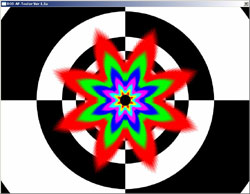 |
| Optimizations Off | Optimizations On |
Most noticeable is the decreased amount of blending that occurs between MIP maps (color bands), which is a result of the trilinear optimization. This effect is often not apparent during gameplay, though for those with sharper eyes the choice is available with the 61.45s to disable all optimizations. NVIDIA is to be commended for giving the end user the option of choosing either better image quality or somewhat lessened IQ for increased performance when it is needed.
Related Posts:
Related posts:
 Gainward GeForce™ 6800 Ultra / 2100 Golden Sample
 Page 4
Gainward GeForce™ 6800 Ultra / 2100 Golden Sample
Gainward GeForce™ 6800 Ultra / 2100 Golden Sample Page 4
 NVIDIA® GeForce™ 6800 GT PCI Express
 Page 2
NVIDIA® GeForce™ 6800 GT PCI Express Page 3
NVIDIA® GeForce™ 6800 GT PCI Express Page 4
NVIDIA® GeForce™ 6800 GT PCI Express Page 6
NVIDIA® GeForce™ 6800 GT PCI Express Page 7
NVIDIA® GeForce™ 6800 GT PCI Express
NVIDIA® GeForce™ 6800 GT PCI Express Page 2
NVIDIA® GeForce™ 6800 GT PCI Express Page 3
NVIDIA® GeForce™ 6800 GT PCI Express Page 4
NVIDIA® GeForce™ 6800 GT PCI Express Page 6
NVIDIA® GeForce™ 6800 GT PCI Express Page 7