NASCAR Racing 2003 Season was tested using a crowded Daytona track and a camera view set inside of Earnhardt’s cockpit. Graphics settings for detail levels were set at high, with effects and features unchecked; the lighting and shadow options were both enabled to increase the CPUs’ workload.
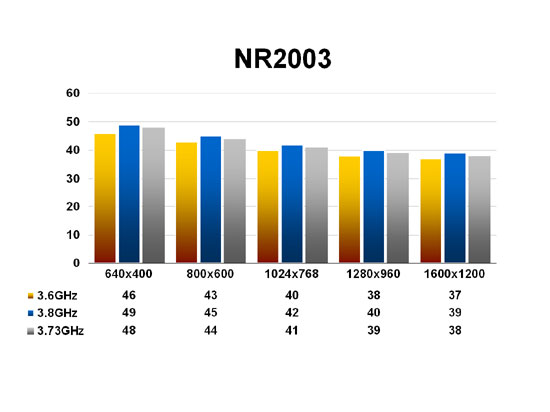
NASCAR parallels the rest of the benchmark suite, again showing a minute performance difference between the processors with the 670 once more gaining the slightest of performance leads.
Conclusion
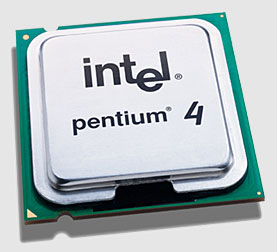 From the perspective of examining the performance results from SimHQ’s benchmark suite, one can understand why Intel needs to transition their desktop processor architecture away from the single-core Prescott. The 670 was able to outperform the 660 at most by only 5% in the lower resolutions of a few titles (notably Pacific Fighters and Call of Duty) — considerably less in the rest of the games tested — and the company certainly appears stalled over the last year with its inability to increase the clock speeds of their desktop parts sufficiently enough to demonstrate tangible performance gains. Furthermore, the heat dissipated by the 670 in the test system was such that the heatsink / fan combo provided by Intel, installed using Arctic Silver 5 thermal compound, was unable to keep the processor cool enough to prevent the part from downclocking itself. Comanche 4, for example, would score around 57-59 fps as opposed to 69 at 640×480, and the 670 would run at over 60 degrees celsius at the desktop. However, the cooling solution that ships in Intel’s retail boxes includes a thermal pad on the heatsink’s base that provides a more even contact area over the CPU cap that covers the processor core, and once this new cooler was installed the 670 was able to run at its full speed. We mention this only to forewarn readers prone to swapping processors for their own comparative upgrade testing, and who therefore might need to consider adding the cost of a heftier cooling solution to a new CPU purchase.
Intel appears stuck in a performance rut for the past year in terms of the company’s desktop processors. Not to sound overly negative, but the Prescott core runs extremely hot for single-core processors, and while Intel currently has good system bandwidth due to support for dual channel DDR2 the design also suffers from high latencies (the test system’s memory timings consist of 4-4-4-12 settings). And insofar as game performance is concerned, their initial dual-core offerings pale in comparison to AMD’s Athlon 64 X2s, though Intel’s production capacity will most likely enable the company to aggressively transition dual core parts down through their various product lines at lower price points than the competition. At the end of the day, however, a site such as SimHQ that covers simulation-based PC gaming finds itself reluctant to recommend Intel’s 670 processor to our readers when there are other parts available on the market that are faster, cheaper, cooler, and quieter.
Related Posts:

Related posts:
 Dueling Dual Cores: AMD vs. Intel
 Intel 925X Express Chipset and Pentium 4 3.4 EE CPU Review Page 5
 Intel Dual-Core Pentium Performance
 Page 4
Intel Dual-Core Pentium Performance
Intel Dual-Core Pentium Performance Page 4
 Intel Pentium 4 670 3.8GHz
 Page 2
Intel Pentium 4 670 3.8GHz Page 3
Intel Pentium 4 670 3.8GHz Page 4
Intel Pentium 4 670 3.8GHz
Intel Pentium 4 670 3.8GHz Page 2
Intel Pentium 4 670 3.8GHz Page 3
Intel Pentium 4 670 3.8GHz Page 4