by John Reynolds
Introduction
 While Intel has not yet announced an official release date for their first dual-core processors, the company has decided to bring market attention to this halcyon change in their future CPU lineup by seeding the hardware and gaming media outlets with early samples. The market has been humming lately with rumors and expectations over the performance gains dual-core processors are expected to bring to the x86 platform, but SimHQ would like to stress that today’s article is a performance preview-a sneak peak, if you will-and not a review of an actual product launch. Nevertheless, the 840 was tested against our standard in-house benchmark suite in the hope of gleaning a general idea of how these processors may perform with today’s game software. As for Intel’s competition, no doubt AMD are also hard at work on their dual-core parts, and though neither company has announced exact release dates we can expect the battle over dual-core dominancy to intensify later this year (perhaps by early summer).
Based on the Prescott architecture, the Pentium 4 840 Extreme Edition Intel has sent SimHQ is clocked at 3.2GHz and contains in its rather large chip-230 million transistors-two separate processor cores. The CPU has a front-side bus speed of 800MHz, unlike the 1066MHz of Intel’s latest Extreme Edition processors, and is fabricated using a 90nm process. The 840 uses the LGA, 775-pin socket format Intel introduced last year yet is not compatible with the company’s current core logic chipsets (such as the 915/925x), requiring instead to run on the upcoming 945 / 955x chipset. Each of the two processor cores shares the same bus to the memory controller in the north bridge of the new chipset, and each CPU core has 1 MB of L2 cache, a combined total that equals the L2 cache now standard in the Prescott-based 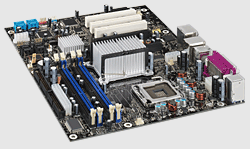 Extreme Editions and 600 series CPUs. AMD’s first dual-core, reportedly an Opteron part, will also see its memory controller shared by the two cores, though as with all A64 processors it will be on-die rather than within the core logic chipset. Like the Pentium 4 600s, the 840 also supports the latest Intel features, such as advanced power management, hyper-threading, and EM64T; the first of these features, advanced power management, is particularly important since the larger die of dual-core processors will naturally produce more heat, and thus the parts’ ability to dynamically adjust clock speed and voltage will hopefully allow the CPUs to run cool.
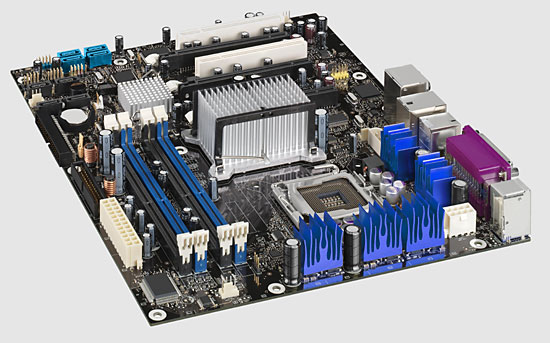
The 955x chipset-based reference board Intel supplied for testing with the 840 is extremely similar to the 925x chipset in terms of its feature-set, though the new board sports a second PCI Express slot for dual graphics card support. The second slot, however, has only four lanes compared to the full 16x of the standard PCIe slot, requiring graphics cards to auto-negotiate the reduced data transfer. Intel claims that compatibility should not be a problem, and SimHQ hopes to test this in the near future.
Test System Setup
- Intel Pentium 4 840 (3.2GHz) and 3.73GHz Extreme Edition CPUs
- Intel 955x reference motherboard
- 1 GB (2×512 MB) Micron DDR2 533MHz memory
- ATI Radeon X800 XT 256MB PCI Express graphics card (Catalyst 5.4)
- Windows XP Professional (SP2)
- DirectX 9.0c
The benchmark suite used to evaluate this test system is listed here. As standard practice, 32-bit color and trilinear texture filtering are the default baseline during testing, and anti-aliasing and anisotropic texture filtering are disabled throughout all tests, along with ATI’s A.I. optimizations. Also, Windows XP Professional was configured to have Automatic Update, System Restore, and all unnecessary startup services disabled. And the licensed version of Fraps 2.5.5 was used to record performance scores unless otherwise noted.
We decided to test the 840 against Intel’s single-core processor with the highest clock rate, the 3.73GHz Extreme Edition, which is also based on the Prescott stepping. Both CPUs were ran on the 955x reference board, with the 840 running on a 800MHz front-side bus and the 3.73 on a 1066MHz FSB. SimHQ also decided that it was time to update our benchmark suite by adding Pacific Fighters, Maddox Games’ newest expansion to their IL-2 series, and replacing Far Cry with the latest Splinter Cell title, Chaos Theory.
Related Posts:
Related posts:
 Dueling Dual Cores: AMD vs. Intel
 Intel Dual-Core Pentium Performance Page 2
Intel Dual-Core Pentium Performance Page 3
Intel Dual-Core Pentium Performance Page 4
Intel Dual-Core Pentium Performance Page 2
Intel Dual-Core Pentium Performance Page 3
Intel Dual-Core Pentium Performance Page 4
 Intel Pentium 4 670 3.8GHz
 Page 5
Intel Pentium 4 670 3.8GHz
Intel Pentium 4 670 3.8GHz Page 5
 Intel’s Core 2™ Extreme QX6700: Quad Core Performance Preview Page 2
Intel’s Core 2™ Extreme QX6700: Quad Core Performance Preview Page 6
Intel’s Core 2™ Extreme QX6700: Quad Core Performance Preview Page 2
Intel’s Core 2™ Extreme QX6700: Quad Core Performance Preview Page 6