Game Benchmark Scores
As a watershed title for multi-processing support, SimHQ enjoys making heavy use of Falcon 4: Allied Force for dual-core testing. The two mission tests that are used in this article can be found here and the simulation itself was patched with the 1.0.7 update. Because of the rather aged nature of its graphics engine, F4:AF was tested only at the resolution of 1024×768, with average frame rate and a histogram of each test as recorded by FRAPS listed below.
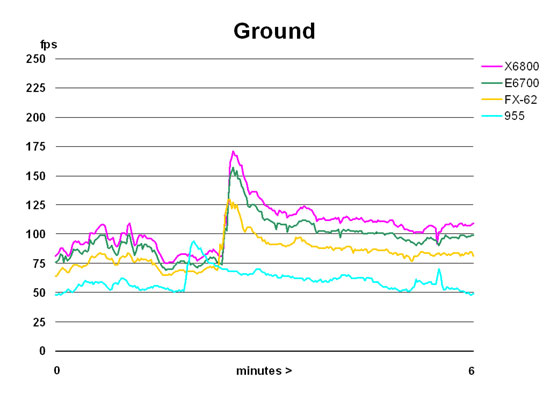
Test 1, titled Ground, is a short MUD moving flight that leaves Mandumi, heads over the FLOT, and attacks an enemy supply depot that has heavy AAA and SAM protection. Performance is recorded during the first six minutes of the mission with the scores shown representing the average frame rate.
|
Ground (average fps)
|
|
|
X6800
|
107
|
|
E6700
|
94
|
|
FX-62
|
79
|
|
955
|
63
|
There’s an incredibly large performance delta between the four tested processors in the above scores. The 955 unsurprisingly comes in last with 63fps and is outscored by the FX-62 by roughly 25%. The two Core 2 processors, however, explode past AMD’s fastest with scores that are 15% and 35% higher for the E6700 and X6800, respectively. While the E6700’s result of 94fps is in and of itself a very strong showing for Core 2’s design in this particular title, the X6800’s higher frequency (2.93 vs. 2.67 GHz) allows F4:AF to scale amazingly well in performance. And looking at the histogram generated by FRAPS we see the two Core 2 processors creating very high frame rate spikes, particularly the X6800.
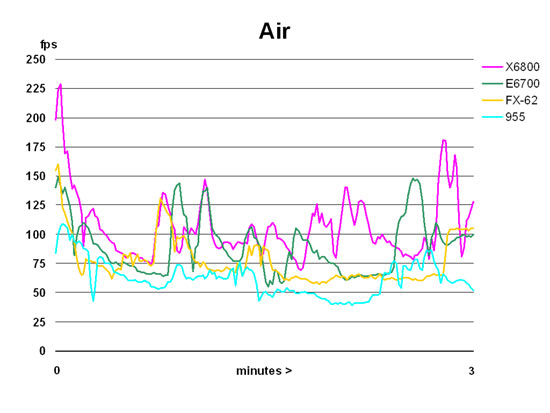
Test 2, Air, is also based on the Korea map. The mission starts with the threat warning siren blaring as the flight comes under immediate attack by Su-27s. The Air mission is shorter than the Ground test, with the frame rate recorded for three minutes.
|
Air (average fps)
|
|
|
X6800
|
103
|
|
E6700
|
90
|
|
FX-62
|
72
|
|
955
|
59
|
The air testing resulted in a pattern similar to the Ground test scores, with the 955 again falling well behind the other processors. The FX-62 in turn lags behind the E6700 by 25% and the X6800 by an eye-opening 45%. Again, the Extreme processor’s higher clock frequency sets it above the slower Core 2 part by almost 15% and the histogram again displays very high frame rate spikes compared to the 955 and FX-62. The performance table has been soundly overturned for the Falcon 4 community, with Intel’s Core 2 assuming a commanding lead over AMD’s fastest dual-core A64 processor.
With the PC market still heavily dominated by titles that do not support dual cores, the performance of these parts in various simulations and games still requires some testing. Pacific Fighters is first up, configured to run in OpenGL mode with all video options set between a mix of high and medium settings and tested using the in-game “F4F vs. G4M” track.
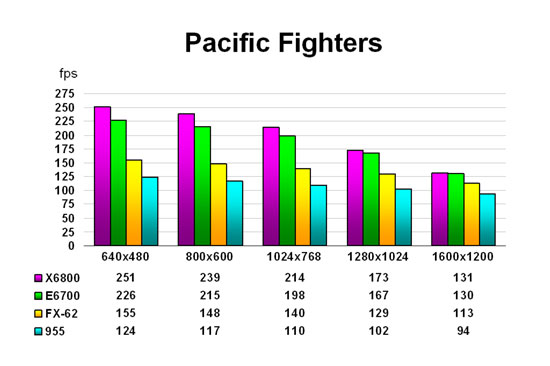
If the F4:AF tests were a strong initial showing for Core 2, Pacific Fighters takes things to a new level. To be honest, we were taken aback at the numbers being produced at the lower resolutions by this particular title, so much so that all tests for the Core 2 processors were repeated multiple times. System and game settings were double- and triple-checked, yet the above scores were consistently repeated. Which leaves us with the assumption that Pacific Fighters must make heavy use of SSE instructions to display such an amazing performance leap above and beyond the other tested processors, particularly the FX-62. The E6700 outscores the FX-62 by roughly 50% and the X6800 by 65% at 648×480, though naturally this margin decreases with higher resolutions. Yet even at 1600×1200 the performance delta remains at a solid 15-20% for the two Core 2 processors.
Related Posts:

Related posts:
 Core™ 2 the Extreme: Intel Retakes the Field
 Page 2
Core™ 2 the Extreme: Intel Retakes the Field Page 3
Core™ 2 the Extreme: Intel Retakes the Field Page 5
Core™ 2 the Extreme: Intel Retakes the Field Page 6
Core™ 2 the Extreme: Intel Retakes the Field
Core™ 2 the Extreme: Intel Retakes the Field Page 2
Core™ 2 the Extreme: Intel Retakes the Field Page 3
Core™ 2 the Extreme: Intel Retakes the Field Page 5
Core™ 2 the Extreme: Intel Retakes the Field Page 6
 Intel’s Core™ 2 Extreme QX9650: Holding the Field Page 7
 Intel’s Core 2™ Extreme QX6700: Quad Core Performance Preview Page 2
Intel’s Core 2™ Extreme QX6700: Quad Core Performance Preview Page 4
Intel’s Core 2™ Extreme QX6700: Quad Core Performance Preview Page 2
Intel’s Core 2™ Extreme QX6700: Quad Core Performance Preview Page 4