by John Reynolds
Times Are A-Changin’
The PC is ever-evolving, with new features and technologies brought to market at what feels at times as an almost monthly basis. Yet this constant influx of new technology is in somewhat stark contrast to other aspects of the PC that marches to a decidedly slower pace: form factors, core logic, I/O buses, and other similar industry standards. Intel, however, is changing this situation this year with the introduction of the 9xx chipsets and their support for new technologies such as PCI Express, High Definition audio, the LGA-775, or Socket T, format, and DDR2 memory.  In fact, one could argue that with this launch Intel is making the most significant platform change of the past decade. And SimHQ will put the potential real-world benefits of this new platform, combined with a Pentium 4 3.4 GHz Extreme Edition processor, to the test by evaluating it against our simulations-based benchmark suite.
Feature-rich Foundations
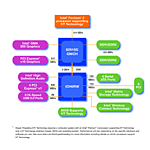
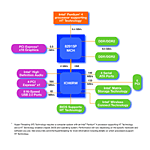
The 9xx series is comprised of the 925X (Alderwood) and 915 (Grantsdale) chipsets, the former aimed at high-end enthusiasts and the latter for the mainstream market. The two chipsets are essentially the same in their features list, which is as follows:
- PCI Express Bus Architecture
- Dual Channel DDR2 533 MHz memory
- Intel GMA 900 integrated graphics
- High Definition Audio
- Matrix Storage Technology
- Wireless Connect Technology
 |
 |
 |
| 915g Chipset Process Diagram |
915p Chipset Process Diagram |
925x Chipset Process Diagram |
PCI Express is perhaps of the most interest to hardware enthusiasts, and is certainly the most important change to the PC bus architecture in years. This new I/O bus is a serial, bi-directional connection that gives 2.5 gigabits of bandwidth per lane. With embedded clock signal and data encoding overhead, this translates to roughly 125 MB per second. Yet each PCI Express lane can be grouped with additional lanes, which is where PCI Express graphics comes in; essentially a 16-lane array or configuration, PCI Express x16 improves upon AGP 8X’s bandwidth by a considerable margin. Moreover, its bi-directional design allows for graphics boards to write to system memory, which will certainly facilitate the performance of advanced features such as vertex instancing. The 9xx chipset series will support one x16 slot and up to four x1 slots, the latter useful for expansion boards such as network and sound cards; older PCI slots are also present for legacy hardware support, and what combination of the two is used will be determined by individual motherboard manufacturers. The Intel motherboard used in the test system for this article has four PCI and two PCI Express x1 slots.
The 925X and 915 chipsets both support dual channel DDR2 400 and 533 MHz memory for a system bandwidth of 6.4 GB/sec and 8.5 GB/sec, respectively. The 915 also supports traditional dual channel DDR and manufacturers will be able to support DDR or DDR2, or both. In addition to this increased bandwidth, the 925X’s north bridge chip (82925X) offers increased memory performance over the 915’s (82915P) by inserting “opportunistic maintenance commands” (think improved prefetch commands) in the data path and minimizing latencies by optimizing access times via rearrangement of data stored in memory.
Intel’s Graphics Media Accelerator 900 is the company’s third generation integrated graphics solution, and offers significant features and performance improvements over previous offerings. GMA boasts support for DirectX 9 and OpenGL 1.4, a 333 MHz clock speed, a maximum of 8.5 GB of bandwidth (system bandwidth when used with 533 MHz DDR2 memory), 4 pixel pipelines, and includes hardware support for Pixel Shader 2.0. Worth noting, however, is that Vertex Shader 2.0 support is software-based, so related tasks will be performed by the CPU. And while the GMA’s fill rate and shared system bandwidth are insufficient to allow it to be competitive with even mainstream add-in graphics boards, the impact of its PS 2.0 support with game developers as the 9xx chipsets begin to saturate the market this year could be important in terms of advancing DX9-class technology in upcoming PC titles.
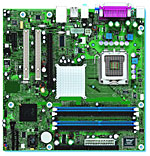 |
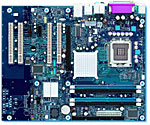 |
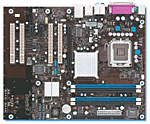 |
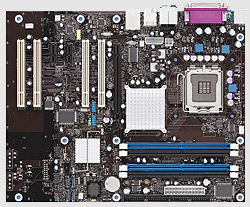
| 915g Motherboard | 915p Motherboard | 925x Motherboard |
Integrated audio solutions are often inadequate for the needs of those who seek an immersive aural environment. Intel’s High Definition Audio looks to change that. A 192 kHz, 24-bit 8-channel onboard audio system, HDA also supports audio formats such as DTS, Dolby, and THX. And possibly more important to the business market, HDA also boasts support for 16-element array microphones for superior voice recognition.
Next is Intel’s Matrix Storage Technology, which is essentially Serial ATA RAID support. Offering four Serial ATA ports, Matrix Storage allows for a RAID 0 + 1 setup on only two hard drives. This is possible because rather than being required to stripe (RAID 0) across the full drives, the Matrix technology stripes across half of two drives, and then mirrors (RAID 1) the remaining half. This theoretically gives the disk performance boost of striping while providing the data integrity of mirroring. In addition, the serial ATA ports include Native Command Queuing, which looks to improve performance for even single drives by reorganizing data access commands.
Last, the Wireless Connect Technology is integrated 802.11 g/b support found in the south bridge chip (ICH6RW). PCs sporting the ICH6RW will be able to connect to wireless networks or even act as hubs or access points for new networks. From a hardware or high-end gaming perspective, this technology is probably not the most fascinating of the features listed, but, again, as the 9xx series proliferates throughout the corporate market it could have widespread implications for the adoption of wireless connectivity.
As mentioned above, the Alderwood and Grantsdale chipsets bring perhaps the most significant platform and architectural changes the market has seen over the past decade. PCI Express will eventually replace both AGP and PCI, the GMA 900 graphics could help promote the use of newer graphical features by game developers, and will certainly help maintain Intel’s current leadership in overall graphics market share, and High Definition Audio might seriously challenge the traditional add-in board sound card market. But what good is new core logic — even one as feature-rich as the 9xx series — without the latest in processor technology to drive it?
Related Posts:

Related posts:
 Intel 925X Express Chipset and Pentium 4 3.4 EE CPU Review Page 2
Intel 925X Express Chipset and Pentium 4 3.4 EE CPU Review Page 3
Intel 925X Express Chipset and Pentium 4 3.4 EE CPU Review Page 4
Intel 925X Express Chipset and Pentium 4 3.4 EE CPU Review Page 5
Intel 925X Express Chipset and Pentium 4 3.4 EE CPU Review Page 2
Intel 925X Express Chipset and Pentium 4 3.4 EE CPU Review Page 3
Intel 925X Express Chipset and Pentium 4 3.4 EE CPU Review Page 4
Intel 925X Express Chipset and Pentium 4 3.4 EE CPU Review Page 5
 Intel Dual-Core Pentium Performance
 Intel P4 3.46EE CPU and 925XE Chipset Review
 Page 4
Intel P4 3.46EE CPU and 925XE Chipset Review
Intel P4 3.46EE CPU and 925XE Chipset Review Page 4
 Intel Pentium 4 670 3.8GHz