by John Reynolds
Introduction
 When Intel introduced the Prescott processors this past summer the event was received by the online hardware and gaming community with less enthusiasm than what past Intel launches have garnered. Manufactured using Intel’s 90nm process, the Prescotts did not exhibit the traditional benefits of new fabrication techniques, which have been reduced voltage and heat that allow for higher clock speeds. In fact, the P4 3.6 GHz processor, announced this June, did not become available on the market until late September, some three months after its introduction, giving Intel time to make minor changes to the core-a new stepping, as it’s referred to in the industry-to alleviate some of its heat issues. The company’s recent cancellation of the expected 4 GHz Prescott and announced new focus on means to increase processor performance aside from the tradition of higher core frequencies clearly indicate a paradigm shift in Intel’s market strategy.
In addition to the new Prescotts, Intel also released its 9xx chipset architecture, a 800 MHz front side bus design that offered a host of advanced features, such as a new serial bus, PCI Express, support for dual channel DDR2, wireless networking, and 8-channel onboard audio. Yet despite its forward-looking feature set, from a performance perspective the new chipset did not offer power users a clear motivation to upgrade. The brass at Intel were certainly aware of the above situation, and have worked to quickly bring to market an answer: the 925XE Express chipset, an update to the 925X chipset that sports a 1066 MHz front side bus. Moreover, Intel claims that the 925XE includes an improved MCH (memory controller hub) that has wider data buses and specialized arbitration for greater throughput and lower latencies. We’ll see what impact the faster FSB has on SimHQ’s benchmark suite. A brief list of the 925XE features is as follows:
- PCI Express Bus
- Dual Channel DDR2 533 MHz memory
- Intel GMA 900 integrated graphics
- High Definition Audio
- Onboard RAID 1 + 0 support
- Wireless network connectivity
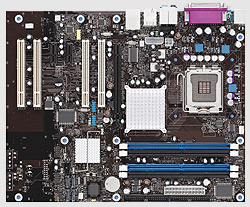 As described in SimHQ’s review of the 925X chipset earlier this summer, and probably of most interest to the gaming community, PCI Express is a serial, bi-directional connection that offers 2.5 Gbits of bandwidth per lane, which gives a real-world throughput of roughly 125 MB per second. Where the PCIe bus gets interesting, however, is that each lane can be grouped with additional lanes for increased bandwidth. Replacing AGP as the new graphics bus, PCI Express x16 is a 16-lane array that essentially doubles the bandwidth of AGP 8x. Yet regardless of this increased throughput between the system’s memory and the graphics card, very few games, if any, display a direct benefit from the new graphics bus; the performance of current games is simply not based on or influenced by a system’s graphics bus (PCIe or AGP), though this could certainly change with future games. That said, PCI Express’ design will allow for interesting options, with motherboard vendors readying dual PCIe graphics slot boards for this fall.
Pricing on the P4 3.46 GHz EE processor will be $999 in units of 1,000 and roughly $180-190 for 925XE-based motherboards (Intel will charge $50 for the chipset itself).
Test System Setup
- Intel Pentium 4 3.4 GHz and 3.46 GHz Extreme Edition processors
- Intel D925XCV (925X) and D925XECV2 (925XE) motherboards
- 1 GB (2×512 MB) Micron DDR2 533 MHz memory
- ATi Radeon X800 XT 256MB PCI Express graphics card (Catalyst 4.10)
- Maxtor MaXLine III (16 MB buffer) 250 GB native SATA hard drive
- Windows XP Professional (SP2)
- DirextX 9.0c
The benchmark suite used to evaluate this test system is listed here. As standard, 32-bit color and trilinear texture filtering are the default baseline during testing. Anti-aliasing and anisotropic texture filtering are, of course, disabled throughout all tests. Also, Windows XP Professional is configured to have Automatic Update, System Restore, and all unnecessary startup services disabled. Fraps v2.3.2 is used to record performance scores unless otherwise noted. While SimHQ traditionally tests the games included in our benchmark suite using high in-game settings, because the clock speeds of the processors are so minute (60 MHz), lower, less demanding, settings were used to allow the two test systems to differentiate their performance scores, if possible.
The P4 3.46 GHz Extreme Edition processor Intel has provided for testing with the 925XE chipset is a 775-pin, Socket T part. Unlike past designs, the Socket T format has moved the connection pins from the processor to the motherboard, leaving flat contacts called a LGA (Land Grid Array) on the bottom of the processor. The P4 3.46EE naturally includes the usual 512K of L2 cache and 2 MB of L3 cache found in Intel’s Extreme Edition processors. Of the most interest, however, is that the CPU is still a 130nm rather than 90nm part.
Related Posts:
Related posts:
 Intel 925X Express Chipset and Pentium 4 3.4 EE CPU Review
 Page 2
Intel 925X Express Chipset and Pentium 4 3.4 EE CPU Review Page 4
Intel 925X Express Chipset and Pentium 4 3.4 EE CPU Review Page 5
Intel 925X Express Chipset and Pentium 4 3.4 EE CPU Review
Intel 925X Express Chipset and Pentium 4 3.4 EE CPU Review Page 2
Intel 925X Express Chipset and Pentium 4 3.4 EE CPU Review Page 4
Intel 925X Express Chipset and Pentium 4 3.4 EE CPU Review Page 5
 Intel Dual-Core Pentium Performance
 Intel P4 3.46EE CPU and 925XE Chipset Review Page 2
Intel P4 3.46EE CPU and 925XE Chipset Review Page 3
Intel P4 3.46EE CPU and 925XE Chipset Review Page 4
Intel P4 3.46EE CPU and 925XE Chipset Review Page 2
Intel P4 3.46EE CPU and 925XE Chipset Review Page 3
Intel P4 3.46EE CPU and 925XE Chipset Review Page 4