Be Sure To Read Part One of This Article: A-10s Over Northern Iraq, Southern Iraq, and Bosnia
The Balkans, Part Two: Kosovo
Just three years after the bombing campaign over Bosnia-Herzegovina, NATO was once again at war with Serbian forces. This time, the conflict was over Kosovo, another region of Yugoslavia experiencing ethnic unrest and conflict and which had also sought independence from the country.
Starting in late 1998, the world’s attention was focused on the conditions of ethnic Muslim Albanians living in Kosovo, who made up a vast majority of the population, but who had been increasingly repressed by the ruling Serbian minority in power. Long-simmering ethnic distrust and strife came to a head in early January 1999 with the killing of 45 ethnic Albanians by Serb forces. NATO began to stress that military options would come into play if Serbian President Slobodan Milosevic did not begin to comply with conditions set in a 1998 cease-fire negotiated with rebels of the Kosovo Liberation Army (KLA). By the end of the month, the US had sent more naval air power to the Adriatic Sea to back up the threats, and tensions steadily mounted in the region. On January 30, NATO ambassadors gave the go-ahead for the use of military force if Milosevic didn’t comply with the 1998 terms within a week.
More talks immediately ensued between the KLA and Yugoslavian officials, as President Clinton committed US forces to any future NATO action and ordered more than 50 aircraft deployed to the region in preparation for such action. A peace plan was conditionally agreed to by both sides in late February, however, Serbian officials refused to sign the document, objecting to one of its conditions that allowed NATO troops to operate in Kosovo. Soon, media reports increasingly focused on the massive flow of ethnic Albanian refugees from the region (about 270,000 as of the middle of March), as well as reported atrocities being committed against them by Serbs. Despite intense diplomatic efforts, Serbian officials refused to sign a final version of the peace agreement. On March 24, 1999 NATO initiated military action against Yugoslavia, with the stated intent to stop the Serbian offensive against civilians in Kosovo and to damage Serbia militarily. The Hog was about to earn another blood chit in the skies over the Balkans.
Operation Allied Force (March 24 – June 20, 1999)

The initial NATO strikes, the first time in 50 years that the alliance attacked a sovereign nation, were spearheaded by cruise missiles, precision-guided missiles and bombs and other “smart” weapons designed to minimize casualties to civilians, while focusing on Serbian air defenses and infrastructure. In fact, in his book “Waging Modern War,” Supreme Allied Commander General Wesley Clark states that the basic outline of Operation Allied Force was designed more than a year prior, and based largely on a smaller model of the campaign launched against Iraq in 1991. It was largely a US plan, focusing on several levels of targets, both of strategic nature in Serbia and later on the tactical level in Kosovo. The role of the A-10 in the early strikes of Allied Force appears to have been minimal, due largely to poor weather, as well as the type of precision attack favored by the Allies at this stage. There was also a very clear political and military statement by Allied leaders that NATO forces were being exceptionally careful to avoid any casualties among the striking aircraft and crew, and relying heavily on high-altitude strikes to hit targets, for fear of taking losses due to Serbian AAA and missile fire.
As of March 30, US and NATO forces publicly were stating that the A-10s, based at Aviano AB and Gioia del Colle, Italy, had not been used in offensive operations to date, citing the continued strength of the existing Serbian air defense system. During a briefing, US Admiral Scott Fry specifically addressed the issue of the A-10s.
With respect to the A-10s, you get back to the issue of the robustness of his air defense systems. It isn’t just the mobile SAMs and the communication links between them and the radars, but there are thousands of MANPADs, and once you get down below 15,000 feet with the weather as bad as it’s been, but even in good weather, worse in good weather, you’re going to place our pilots at a tremendous amount of risk, and we’ve got to weigh that as we proceed with this campaign.
What they didn’t state at that time was that although the use of the A-10 had been light up to that point, the aircraft had already played a significant part in a mission that would become part of the Warthog’s repertoire just as much as close air support was….combat search and rescue.
Hogs to the Rescue – CSAR over Yugoslavia
On March 27, 1999, an F-117 Nighthawk “stealth fighter” was downed by Serbian air defenses about 25 miles from Belgrade, the capital of Yugoslavia. It was a night of terrible weather, but as soon as word came that the pilot was down behind enemy lines, a three-helicopter search and rescue team headed by Capt. James L. Cardoso in a MH-53 Pave Low helicopter scrambled from their base in Croatia. The rescue force reached the general area before any supporting assets did, and Serbian forces were jamming and sending false reports, so the helicopters landed just outside of the Serbian border to await more Allied units to assist in the operation. Realizing that they would need more fuel to conduct the rescue, the force took off and refueled from an MC-130, all in a lights-out configuration and just a few miles inside the Croatian border. Serbian radar would easily spot the formation if they climbed to a higher altitude, so Cardoso arranged for the refueling to be conducted using nothing but night vision goggles, and hitting the tanker at an altitude of about 700 feet.
While the helicopters were preparing to cross into Serbia, the commander of the rescue operation, Capt. John Cherrey, was trying to determine the pilot’s location on the ground from his two-ship A-10 flight, call sign Sandy. As he conducted his search, SAM radars repeatedly washed over him, but by taking such risks, Cherrey was able to identify the downed pilot’s location to within a mile. The helicopters raced across the border at less than 100 feet, flying without terrain following radar and using only night vision goggles.
The forces learned from the downed pilot that he was near a road intersection, essentially surrounded by unknowing search teams and dogs. Wanting to make the Serbs believe the pilot was elsewhere, Capt. Cherrey flew his A-10 flight away from pilot’s actual location and into the range of nearby SAM batteries.
With his infrared rescue beacon broken and with nearby Serbs temporarily distracted but homing in on his radio transmissions, the F-117 pilot was ordered to fire a flare to mark his exact position. As the helicopters watched, less than half a mile away, the flare cut through the night, alerting everyone nearby to his hiding spot. Cardoso placed his Pave Low between the downed pilot and a group of approaching Serbs, while an MH-60 landed next to the pilot and disgorged a team of pararescuemen to authenticate the pilot’s identity and grab him. The rescue force then exited Serbia at treetop level, with the smaller MH-60 wedged between the two larger Pave Lows for protection. The rescue force dodged gunfire and searchlights to land safely at an airbase in Bosnia. During the course of the rescue, the MC-130 itself, both A-10s, and the helicopters all had been refueled at dangerously close locations to the Serbian border, and in the case of the A-10s, with very little fuel remaining on-board.
“There’s a great sense of relief in that the guys I was working with were doing such great work,” said Cherrey in an interview after the conflict. “Every time we would come up against an obstacle, one of these guys would say, ‘Hey, I’ve got it.’”
For their part in the rescue, Cardoso and MH-60 pilot Chad Franks earned Silver Stars for their performance under fire, as did Capt. Cherrey, the only A-10 pilot to earn the medal during the conflict.

First Blood for the Hogs
As late as the first week of April, NATO commanders were still addressing media inquiries of when the Italian-based Warthogs would be flying offensive missions on their own. They began to indicate, however, that the A-10 pilots had started to fly in larger strike packages, serving in roles of Airborne Forward Air Controllers (AFAC) and CSAR support.
On April 2, a NATO commander said that the Warthogs “have been very helpful in helping other planes keep track of armored columns and deployments, so they can vector in to attack them. The A-10, also in part because of its loiter capability, is a very important part of the combat search and rescue operations.”
That official line….that the A-10s were being used solely for observation, FAC, and CSAR, continued until April 7, when it was announced that in the previous 24 hours, A-10s, along with aircraft from the USS Roosevelt, participated in strikes in the southwest part of Kosovo against a set of nearly 30 targets. As NATO felt comfortable that the Serbian air defense system was being eroded, the Warthogs began to see more and more ground attack missions tasked their way.
On April 8, the world saw the Hog in action from those initial strikes when video from an A-10 attack was highlighted at a NATO press briefing.
On this particular film, same one, but you’ll see a highlighted area in the upper right hand corner of the screen, and you’ll see flashes. This is the same one I showed you a moment ago. That’s AAA, air-to-air artillery, being fired at this A-10, probably either 23mm or 37mm. You can see the flashes coming on. He sees this himself as he’s coming in.
The ground flashes and then the tracer airbursts, you’ll see that usually only the tracer is about every fifth or sixth bullet, so he’s taking what we would consider moderate to heavy AAA all the way in on this run. So as I explained earlier, this is not without risk.
Later in the briefing, another A-10 video is shown, this time highlighting an aborted mission on a convoy.
The next video we’ll show you will be that we are picking up convoys in the engagement area. This is a Maverick on an A-10, again, with a convoy. You’ll see he has to break this off. He does not attack it. The reason is he’s being fired at. But he does relay that information of that convoy back to other aircraft, and our understanding is that was probably attacked by other aircraft later.
Casualties of War
As April rolled on, the opportunity to find fairly ‘easy’ targets, like convoys, decreased rapidly as Serbian forces began to hide their vehicles more effectively and not rely on daytime road traffic. That, combined with the high altitudes that most of the NATO missions were being flown at, began to severely task A-10s and other aircraft from more effectively hitting targets. In the case of an A-10 flying in the FAC role, the difficult terrain below, the relatively poor high altitude performance of the aircraft, the lack of sophisticated sensors on board, and the small, hard-to-find targets below made the task especially difficult. However, the strength of the aircraft, mainly its long loiter time and survivability features, made the Hog a very key player in the air campaign. Four additional A-10s were part of an increase in US aircraft to the region on April 10, along with about two dozen F-16CJ “Wild Weasels,” KC-135 and KC-10 tankers, and C-130 transports.
By the middle of April, NATO was increasingly feeling pressure from a number of strikes that had killed civilians. On April 21, an errant and possibly malfunctioning cluster bomb landed in the city of Nis, killing several and causing the weapon to be removed from US strikes for several days. On April 12, a train on a bridge was hit and 10 civilians reportedly died. Two days later, Yugoslavia claimed that upwards of 70 civilians were killed when a refugee vehicle convoy was attacked by NATO aircraft. A post-war speech by Brigadier General Daniel P. Leaf suggests that an earlier flight of F-16s acting as FACs had cleared the attack, but after some confusion about the targets following the first strikes, Cub Flight, a two-ship of OA-10s acting as FACs, was asked to come into the area and better identify the targets. According to Leaf, Cub flight had clearly identified military vehicles in the convoy, but also said that multicolor and possibly civilian vehicles were part of the convoy as well, leading to the termination of the attack.
Regardless of the truth behind this incident, the cost of operating at high altitudes, and in conditions that often favored the defender, was taking its toll. As information came out about the attacks, more questions were raised about the process for dropping ordinance. At one press briefing on April 14, Major General Wald, a former FAC pilot himself, addressed some of the challenges of the position.
But I can say that the way these missions work in Kosovo with a forward air controller — either an A-10 or an F-16 forward air controller — is that the forward air controller will be cued to a target area by possibly an off-board sensor or some other report, or possibly he will be looking in the area himself and find what could be a military target. That cueing could come from Predator, could come from JSTARS, could come from, once again, from the pilot himself finding the target.
In the case of an A-10, he will find the target; he will identify it actually using binoculars, very slow speed — and reports I’ve heard today and from last night they’re taking heavy AAA and significant SAMs and MANPADS were fired both last night and today. He loiters over the area to identify the target. They’re trained for identifying military targets, as you can imagine, and at that time will call in another set of fighters, probably two, to expend their ordnance on the target. But before they do that, the FAC, forward air controller, will talk to the other set of fighters and make sure they both have 100 percent assurance that they have the correct target, they both identify it, and there’s a verbiage that goes on between the two of them, and just as my answer’s taking a long time, it takes a long time for this to happen…
Q: So it’s eyes on.
Major General Wald: It’s eyes on and conformation both from the forward air controller and the pilot itself — the air crew that’s going to drop the weapon — and the forward air controllers can self-expand, but it’s eyes on, and it’s dual-control from the standpoint there is verification both from the pilot dropping the bomb and the forward air controller through a set of dialogues that goes on. And then, and not until then, is the pilot cleared in to drop the bomb. And once the forward air controller is assured that this pilot is dropping on the right target, he will clear him to drop the bomb. Then from bomb fall until target impact is about 10 to 15 seconds, so through that 10 to 15 seconds, it’s once again basically you’re at the mercy of fate. But the fact of the matter is, in both the mind of the pilot and the air crew that’s dropping the bomb, you have to be in your own mind 100 percent sure of what you’re going on before you actually release. So it’s about as positive control on a weapons release as you can get.
Q: And tractors from the air, filled with people’s mattresses, don’t look like military convoys, would you think?
Major General Wald: I’ve been a forward air controller in Vietnam; I’ve flown in Bosnia these types of missions, dozens of times; I’ve flown them over Iraq, and I can honestly say that if there’s any doubt whatsoever in either the pilot or the air crew that’s dropping the bombs, the FAC or the air crew’s minds, they will not drop. I can also tell you that it’s easy to tell the difference between a tractor and a tank. So yes, I’d answer that you can tell. If there’s any doubt, you just don’t drop.
Considering that the primary tool used by OA-10 pilots for identifying targets were a pair of space-stabilized 12x and 15x binoculars, the job of FAC was a very difficult and tasking one. Despite a heavy reliance on remotely piloted vehicles, reconnaissance flights, and satellite imagery, the most reliable ‘eyes on the scene’ over Kosovo were still a USAF A-10 pilot with binoculars spotting targets otherwise hidden from sight.
This job is superbly outlined in an article that appeared in the August 2001 issue of Flight Journal Magazine. Author Phil “Goldie” Haun is currently a Lieutenant Colonel and a student at the School for Advanced Airpower Studies at Maxwell AFB. However, he has more than 2,000 hours flying the A-10 in operational assignments in England, Korea, and Germany. During Allied Force, he was the squadron weapon officer for the 81st Fighter Squadron at Gioia del Colle, Italy, and flew 37 combat missions. For his actions on the April 15, 1999 mission he wrote about in the article, “A-10s over Kosovo,” he was awarded the Distinguished Flying Cross, and the article clearly illustrates why….between the aircraft he was controlling as a AFAC and his own two-ship of A-10s, he helped destroy five artillery pieces, an APC, five Frog 7 launchers, and an ammunition storage trailer. As Haun says, “Not bad for a day’s work.”
The article also clearly illustrates not only the difficult task of an AFAC, but the challenges that the campaign handed to A-10 crews. First and foremost, the aircraft is not a superb high-altitude performer. During Desert Storm, for instance, it wasn’t uncommon for fully-loaded A-10s to cross the Iraqi border at 20,000 feet plodding along at 200 knots…..barely traveling faster than a WWII heavy bomber. Haun’s situation is less severe than that, but several times in the article he points out the long delay in climbing to altitude (generally hinted at about 15,000-20,000 ft.), finding the target at that height, and launching an attack, while his wingman stays above. While the one A-10 climbs back up, the other covers. This is not an aircraft known for its rate of climb.
What is also very apparent is the FAC’s difficult task in coordinating large numbers of aircraft. For this mission, Haun is the commander of a 45-ship package over eastern Kosovo, and handles aircraft from Canada, the USAF, and the RAF as they come in for attacks, one after the other, in an area around the towns of Gnjilane (‘G-Town’) and Bujanovac. He states that during the course of Allied Force, he coordinated attacks from aircraft from the USAF, USN, Canada, Britain, Italy, France, Spain, Turkey, the Netherlands, and Belgium…all from a single-seat plane with a couple of maps (1:50 and 1:250 are mentioned), a radio, and a pair of binoculars.
Near G-Town, Haun and his wingman, “Dirt,” first investigate some revetments that held armor just two days prior. During that mission, Haun was coordinating some USAF and Belgian Air Force strike aircraft when they saw the smoke trail from a MANPADS coming his way. Both he and Dirt jinked successfully and waited for their first set of strikers to come into the area. A flight of USAF F-15Es was already low on fuel when they arrived, and the pair of A-10s again dodged another MANPADS while attempting an unsuccessful (hung weapon) Maverick attack on the targets themselves. The target is about to be passed to the Belgian F-16s when Haun and Dirt needed refueling themselves. When they returned to the area, weather had closed in the target.

On this day, however, the weather is better. Haun and Dirt have already refueled on the flight from Italy on what will end up being a five hour mission….one hour from Italy to Macedonia for a tanking, one hour over Kosovo, back to Macedonia for another tanking, back to Kosovo for another hour, and then an hour-long flight home. After finding the previous day’s revetments empty, the pair search for more targets around G-Town. They find another set of revetments to the east, filled with eight artillery pieces and two APCs. The first strikers in are CF-18 from the Canadian Air Force, armed with laser-guided 500 lb. bombs. Hoping to show the Hornets where the target is, Haun drops a 500 lb bomb onto one set of revetments. It’s a dud. Backup plan……now it’s time to talk the Canadians (Merc 11) onto the target.
“I respond to Merc 11’s check in, “Copy. We are just east of the target and setting up for another mark. Call visual the factory that is just east of the huge town that is on the east/west hardball.” G-town is then only large town in eastern Kosovo. Merc 11 has eyes on my flight, so the only town they can see is G-town. On the east side of G-town is an enormous factory complex next to the highway leading east out of town.
Merc 11 replies, “Copy. I see one factory. Large structure has a blue-roofed building to the west.” Merc 11 not only responds that he sees the factory, but he confirms it as well by giving a positive description of a distinct feature. I am confident that he has the correct factory in sight.
“That’s affirmative. Let’s use that factory east/west one unit. From the eastern side of factory, go two—-let’s make that three—units east on hardball. Then use factory from hardball. You’ll see a pull-off on the north side of the hardball. Go one unit to the south off the hardball. In between two small towns, you’ll see some light revetments.” I continue the talk-on by setting the length of the factory complex east to west as a unit. I treat that unit as a yardstick and measure the distance along the road to another feature (a pull-off from the highway). I talk Merc 11 down between two towns where the artillery is lying.
Not a job for the faint of heart. After Merc identifies the target, the two flights confirm the location by Merc lasing the target so Haun can confirm it with their Pave Penny pod. After confirmation, Merc flight moves south 10 miles, and sets up his attack run. Two runs, two bombs, and two ‘shacks’ later, two artillery pieces are destroyed before Merc flight declares bingo fuel and departs from the area.
While Merc is attacking, Haun is just south, coordinating with the airborne ABCCC EC-130 aircraft for the next flight in, this time a pair of F-15E Strike Eagles (‘Dragon’ flight). While he’s waiting, Haun pops one of the APCs with a Maverick. After getting a buddy spike from Dragon, Haun marks the target this time with White Phosphorous rockets, which Dragon sees and uses as a marker to commence his attack. Haun and Dirt head for the tanker.
When they finish topping off, it’s time to move on to a new area, since G-Town is now closed in from weather. The pair move to a large valley near the Macedonian border where Serbs have been fortifying positions for an expected NATO ground attack. On one hilltop near the town of Bujanovac, Haun spots six well-concealed revetments that are shaped differently, but which seem to have large caliber artillery in them….they are later identified as Frog-7 launchers.

The next strikers up are RAF Harriers (“Dodge” flight), carrying cluster bombs. Haun uses Mk82s to mark the target now for Dirt, and begins to set up a “five line” for the RAF pilots…..IP, heading, distance, elevation, and coordinates. While he’s doing that, he drops his map, which gets stuck under his seat. Conveniently at the same time, AAA fire from another hill come dangerously close. Haun and Dirt pull away from the target, try to reorient themselves, get in touch with the waiting Harriers, and plan an attack that will use the A-10s to suppress the AAA while the Harriers come in after the artillery. Haun clears the Harriers to enter the area and goes back to finding the now-silent AAA guns. He marks the artillery with another Mk82 and moves on his flight to cover the approach.
As I wait just west of the target, I again turn my attention to the AAA pits. I’ve taken a snapshot in my mind of where the AAA was coming from and the position of the pits. They are only visible when looking southwest to northeast. I do a belly check and I see them directly below me. I call on Fox Mike to Dirt, “OK, I know where those triple-A pits are now.”
Dodge interrupts my call. “Requesting mark one minute thirty.”
“Copy that.” I turn my attention to Dirt. “Try to put in those Mark eighty-twos [on the artillery], and I’ll extend to the northeast.”
Dirt calls back, “Tell me when to roll in.”
“Yeah, as soon as you can.” Dirt drops his three bombs for direct hits on two of the revetments. The explosions carry huge secondaries.
“Visual, in hot.” Dodge sees the mark and requests permission to attack. I clear him and watch as his CBU tears through two more revetments.
As Dodge resets his wingman to drop more CBU, I begin to focus on the AAA sites. I put my binoculars on the position and note four gun pits. They are tiny and impossible to lock up with a Maverick, but I still have my 30mm gun available to strafe them. As I consider my next move, I notice a large truck and a trailer, not more than 100 meters from the pits. It is barely visible in a tree line down a ravine. There is only one reason for that type of vehicle to be there next to AAA pits; it has to be the ammo truck – a far more lucrative target.
This decision is easy. As Dodge 62 begins his bomb run, I call up a Maverick. The AAA, which has been silent, begins to come up as Dodge’s CBU rains down. AAA explodes in a string of pearls just beneath me. This is a pass I only want to make once. I get a steady cross on the truck and hammer down on the pickle button. It seems like an eternity before the 500 pounds of missile begin to move off the rail. In reality, it’s less than a second, and as it accelerates toward the target, I pull off hard and begin jinking. It’s going to take 20 seconds for impact, so I wait a few seconds before rolling the jet over.
The impact takes me by surprise. The missile slams directly into the trailer and sets off a series of secondaries such as I have never seen. Fire reaches for the sky like the Fourth of July.
“Unbelievable,” is all the ever-cool Dirt can muster. More important, the AAA shuts down instantaneously, and Dodge 62 can call for his next mark. Completely out of bombs, I return to place two Willie Pete rockets on the site. Dodge 62 drops good CBU before the flight returns to base.
For more on Lt. Col. Haun’s mission, be sure to read the August issue of Flight Journal. It establishes a fantastic description of the A-10 at war and the challenge of being an AFAC.

New Targets and Close Calls
On May 2, the A-10 community nearly avoided a loss when a Hog flying near G-town was hit by a shoulder-launched missile at medium altitude, suffering engine damage and external damage to the aircraft. The Hog’s engine cowling was ripped off and shown on Serb television as evidence of a downed aircraft. Given the type of damage suffered in the missile attack, it seems likely that the cowling shown on television was from the same A-10 that was hit. The pilot safely returned the aircraft to a friendly airbase in Skopje, Macedonia. The missile strike showed both the heavy use of MANPADS by Serbian forces, as well as the risk posed by these missiles, even at altitude.
Speaking of targets, A-10s were involved in strikes against more and more armor units, as hiding locations were identified. It was also confirmed that the Hogs had fired their tank-killing 30mm cannon for the first time in the conflict. By the time the war was over, more than 31,000 rounds of 30mm. cannon would be expended, on more than 100 missions.
On May 11, another A-10 was reportedly hit. A pro-Serbian website lists the following information, taken from the “RAF Yearbook.”
“Amongst the many encounters by the 81st FS was one on 11 May, when a pair of OA-10s were performing an airborne FAC mission over eastern Kosovo. Pilots Capt. Chris Short, and his wingman Col. Greg Sanders, entered their designated box area from the south and were notified by an E-3 to search for a possible Serbian helicopter. After 15 minutes of fruitless search, they discovered a possible tank revetment south of Pristina airfield. A Maverick missile was fired at the site, although it was not possible to determine if the tank had been successfully hit. The pilots radioed the position of the tank revetment to another FAC team, and departed the area. The A-10s then flew to another location, where earlier in the day two camouflaged APCs had been reported. Two vehicles were detected, but due to low fuel reserves, the pilots were only able to perform two attacks. Capt. Short rolled his A-10 towards the vehicle and fired a Maverick, scoring a direct hit. The second aircraft aimed for the other vehicle, and also fired a Maverick which missed its target. The two aircraft then climbed to altitude to return to the tanker before continuing their patrol. While in the climb, Capt. Short experienced a ‘thump’ on the underside of the fuselage behind the seat. As a defensive measure both aircraft ejected self protection flares. Neither Col. Sanders or Capt. Short could find any damage to their aircraft, so the two pilots resumed their flight after refueling from the tanker. The two aircraft completed their mission, which included delivering Mk82 bombs onto a Serb target in Kosovo. The aircraft then returned to Gioia del Colle. It was only after taxing into the de-arming area that personnel noticed damaged to the underside of the A-10. The FM antenna had been torn away, and there was a large dent on the underside and a black scorch mark. A SAM is believed to have exploded nearby, with Capt. Short having a lucky escape”

More Hogs Arrive
The first week of May also saw an increased number of A-10s moved to the theater. On May 17, eighteen A-10s and more than 2,700 reservists were mobilized from three stateside Air Guard units, the 104th Fighter Wing, Barnes Field, Westfield, Mass, the 110th Fighter Wing, Kellogg Airport, Battle Creek, Michigan, and the 124th Wing, Boise Air Terminal in Idaho. Additionally, several A-10s had been previously redeployed from operations over Iraq, where they had been flying patrols over the no-fly zone there. EA-6 jammer aircraft and F-16s were also moved in the same redeployment.

The Hog Finds Its Element
As May progressed, a focus of the air campaign was shifting from attacking large fixed sites to killing the many Serbian vehicles and emplacements inside Kosovo, although several high-profile attacks that left civilians dead made much of the headlines. In addition, a new goal of the campaign, to disrupt electricity in Serbia, resulted in about 80 percent of the country losing power. However, due in part to the increase in civilian deaths, specifically the April 14 convoy attack, some Rules of Engagement were changed to allow pilots to go below 15,000 ft., the previous hard deck for missions. FACs could now fly at around 5,000 ft., and strike aircraft, around 8,000 ft., although few A-10s descended to these levels, preferring to stay about 15,000 ft. due to the threat conditions. The A-10s focused their energy on Kosovo, and the difficult task of identifying targets and coordinating strikes against them, often in tremendously difficult tactical situations. From General Clark’s book,
“We often saw a picture of a farm house that has tracks going to the farm implement storage shed, and another with a hay stack with a tank clearly hidden underneath, or a treeline with artillery hidden in it. But when you go out from that and see that that’s in the middle of a very populated area with a lot of houses around it…… The translation from the high-resolution imagery into quality targetable data that you pass to the cockpit isn’t as easy as it looks like it would be.”
A threatened ground invasion by NATO troops mobilizing in next-door Macedonia began to draw the public’s attention to the emphasis that the alliance was placing on killing Serbian artillery tubes and armored vehicles, which would obviously be used to counter such an invasion. The deployment of MLRS (multi-launch rocket systems) with long-range ATACMS missiles, and AH-64 Apache gunships, led to increased speculation that a ground campaign was forthcoming. However, military leader insisted that the air campaign as it was progressing was serving its purpose of killing tactical targets. From a Pentagon news conference on May 19, spokesman Kevin Bacon addressed the role of the respective weapons:
Q:…on the MLRS system deployed in Albania, and they talked about a lot of artillery on the border, the shelling across the border in Albania, the reports of the Serbs digging in along the borders to stop a suspected ground attack. It all leads to the question of why hasn’t MLRS and the ATACMS been used against those kinds of targets? They’re very effective against those kind of targets, and they come at relatively low cost to us.
Mr. Bacon: They are very effective, but — as I’ve just said in citing figures that we’ve eliminated a large portion of the Serb artillery — we believe that our A-10s and other planes have been very effective against these targets as well.
Q: How about the troops positions that have been dug in in that area?
Mr. Bacon: We have been attacking those troop positions as well. They tend to be…
Q:…you have — you’ve been inhibited by the weather to do…
Mr. Bacon: We are using the weapon systems we have. They’re called A-10s, and they’re called F-16s, and there are other planes, and we’ve been using them with considerable effect.
While the A-10s were being heavily used, media interest in the plane’s exploits were somewhat hampered by the lack of “wiz-bang” imagery provided from its sensors. Gun camera footage of the 30mm. cannon proved difficult for the untrained eye to ascertain, and the video on the AGM-65 Maverick wasn’t the optimum weapon for making videos that NATO wanted to show to the world’s media, since its video feed to the launching aircraft often ended when the missile was launched.

Alongside the lack of information was confusion about the possible role of the Apache helicopters and the role of the A-10 in the possible upcoming ground war, since the two weapons complement each other in the task of killing ground vehicles. However, there clearly was some wrangling about the need to use the Apache force, when the A-10s seemed to be able to do the same mission with less vulnerability. Ironically enough, the charge to not use the Apache was driven by the US Army, for fear of casualties among its helicopter crews. Their deployment, and failure to see combat, weighs heavily in General Clark’s book. Regardless, the A-10’s role was not going to be diminished by the AH-64s in theater. In fact, it seems likely that if the Apaches were used, A-10s would likely have been used in conjunction with them on strikes. The two aircraft and their crews even flew several training missions together, in preparation for their eventual use, a mission which never came to fruition.
From a briefing on May 19:
Major General Wald: I think all the systems have a little bit different characteristics and capabilities. As you know, Apaches would be very, very good against massed, moving armor-type targets; a C-130, AC-130, in an environment where there are a lot of targets that are moving in mass, type tanks, may not be quite as permissive, let’s say, as it would be in other environments. It’s great against fixed-type targets. And an A-10, of course, is good against maybe kind of a latitude of all those targets across the board depending on the environment. So they all have their own characteristics. Some of them overlap. When the target’s right, the commander will use it against that target.
Q: You say you’re hitting them with bombs. How often do you hit them with guns say from an A-10 or from an AC-130?
Major General Wald: The A-10 I understand has been firing a gun periodically. I don’t know if it’s every mission, but periodically when they have the right target, they’ll fire the gun against that type of target, would be one of them, or other targets.
With the continued role of CSAR, CAS, AFAC, and other jobs, the A-10s found themselves in a wide variety of missions and situations that their designers couldn’t possibly have foreseen as they were developing the jet. One of the more unusual missions for the A-10 community came on May 20, when an OA-10 was flying as a AFAC for a US Navy F-14 Tomcat equipped with laser guided bombs.
Spotting a “Straight Flush” radar system (often used with the SA-6 SAM system), the A-10 pilot was unable to coordinate an attack by the F-14 in its first pass over. Because the A-10 was armed with Mk-82 500 lb. dumb bombs, the two planes switched roles, and the F-14 used its onboard laser to mark the location of the radar for the A-10, which located the target and then dropped its bombs. Here was a situation when two aircraft, both serving jobs that they weren’t truly designed for, performed a mission jointly with success.
Around this same time, the additional A-10s from Massachusetts, Michigan, and Idaho’s Air Guard units arrived in the theater and immediately went to work, claiming five tank kills in the first day, as well as ten artillery pieces and several vehicles. A few days later, a pair of A-10s engaged about ten APCs that they discovered, claiming several kills. The effectiveness of the A-10 and its pilots was finally being ratcheted up, and about 40 Warthogs were now an integral part of the air war. In fact, as the deployed AH-64 Apaches experienced publicized difficulty in getting up to speed, it was clear that the existing airpower, and particularly the A-10s, would be carrying the bulk of the ground attack work should a ground invasion occur, which was still considered likely.
In early June, the role of the A-10 was becoming an increasing feature of the daily press briefings about the war, and on June 2, it was revealed that the A-10 was responsible for quite a few of the attacks on Serbian armor and artillery in Kosovo.
One such attack, highlighted in the USAF Trade Publication Air Land Sea Bulletin, describes an A-10 strike commanded by the very same Phil Haun mentioned in the Flight Journal article.
“A two-ship of A-10 Airborne Forward Air Controllers (AFACs) circle over southwest Kosovo, searching for targets. The Serbians have their equipment hidden and finding legitimate military targets has gotten as difficult as finding the proverbial needle in a haystack. As luck would have it, a ragtag infantry unit of Kosovo Liberation Army (KLA) volunteers comes in contact with the Serbs. The resulting ground fire, indirect fire support, and movement of Serbian Army mechanized equipment to engage the KLA is sufficient to positively identify the Serbian positions. As flight lead of the two-ship, I begin attacking with AGM-65 Maverick air-to-surface missiles and Mk82 500 lb. bombs. I then bring in additional strikers with cluster bomb units (CBU-87), Mk83, and Mk84 bombs, and inflict significant damage to the Serbian ground units.”
It was also made known that a portion of southwest Kosovo was now called “The Hog Pen,” where A-10s were doing the bulk of the work of attacked armored targets, both as AFACs and the actual strike aircraft. As a briefer reported: “Since [the Serbs] are congregating there, that’s where the targets are, and that’s where we’ll continue to attack them.”
That same week, more and more video of Maverick attacks on armor are shown to the world press. The A-10 was clearly being used in its niche’ – killing tanks, a role that it stayed focused on until the end of the war.
On June 9, the Serbs agreed to a cease fire plan that allowed for NATO forces to enter the country in large numbers, and arranged for a Serbian withdrawal from Kosovo within 11 days. A-10s flew some of the last missions of the conflict, attacking Serb artillery on the 9th.. The bombing campaign was suspended the next day, and NATO and Russian troops entered Kosovo independently on June 12. On June 20, the Serbian withdrawal was complete, and Operation Allied Force formally ended.
The Cost and the Outcome
Although several aircraft were downed during the course of the war, no NATO lives were lost during Operation Allied Force, thanks no doubt to the fact that the threatened ground offensive never occurred. The alliance, mostly the United States, flew more than 35,000 sorties in support of the operation….about 450 a day….and the A-10s made up a respectable portion of that number. Hogs were credited with killing more tanks and artillery than any other type of aircraft.
The outcome of the war has been somewhat debatable since its end……post war analysis showed widely varying reports of the actual number of armored units killed, with some reports indicating as few as 14 Serbian tanks were destroyed, a fact that’s been greatly (and probably correctly) disputed by airpower advocates since. However many tanks were killed, the larger air war took a huge toll on the infrastructure in Kosovo and Yugoslavia. Hundreds of thousands of refugees were forced out of Kosovo, or left voluntarily. Scores of bridges, buildings, facilities, and targets were destroyed, and it was later estimated that the war cost Serbia more than $60 billion dollars. Estimates of deaths on the ground also vary widely, ranging from 2,000-5,000, depending on the source. And although NATO forces still are present in Kosovo, the age-old tensions are just below the surface and the future is entirely uncertain for the region.

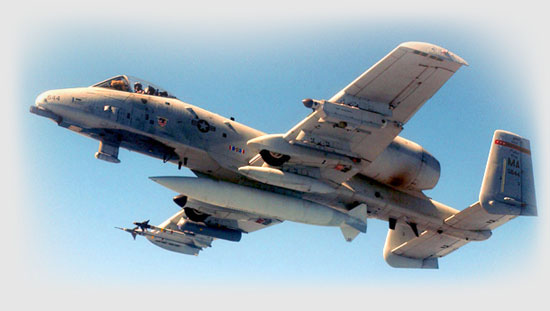
One thing is certain, however. The A-10 Thunderbolt II and its aircrew performed well in the conflict, under much less than optimum conditions and performing mission that were never part of the aircraft’s design. The war in Kosovo, while perhaps a messy political situation, was a clear affirmation of the A-10’s ability to survive and adapt for changing roles.
Conclusion
From the skies over the Iraqi desert to the rugged mountains of the Balkans and southwest Asia, the A-10 Thunderbolt and its crews have performed a wide range of tasks, using a wide range of tactics, and in a wide range of situations, most of which were never envisioned in the early 1970s when the aircraft was being designed and created. The common thread between these situations and tasks has been the enduring performance of the aircraft and its community. In a time when high-tech sensors are the norm, the A-10 proved in Kosovo that sometimes the most effective sensor is the Mk.1, Mod 0 eyeball. When tactics resort to high-speed drops of smart weapons, experience in every theater in the past decade showed that there’s true combat value for ‘dumb’ weapons controlled by the smartest of smart systems, the human pilot. And in a time when aircraft are made more and more complex, the A-10 is a throwback the days of rugged, hands-on aircraft designed to take and dish out punishment. It’s very likely that the Warthog will soldier on for many more years, simply due to the fact that it can do so many tasks so well and that literally, nothing is in service or on the drawing board that can replace it. That is a testament not only to the airframe, but to the pilots who fly the Hog and the ground crew who work on it.
Thanks And Sources
While there is a large amount of information on the A-10’s role in Desert Storm, very little has been published about the conflicts since, much less the role of the Warthog in them. The majority of my sources for this article came from web sites that I considered fairly reputable, such as www.defenselink.mil, www.nato.int, and www.af.mil. I surveyed dozens of transcripts of daily press briefings, as well as scores of articles in military publications and on web sites. While I turned up a large number of references to the A-10, piecing them together proved to be a challenge and, in my opinion, provided a very “wide” piece that in its initial stages was not very “deep”‘ Many of these same sites had information that was not clear, not specific enough, or in some cases, was downright inaccurate. Other, non-official sites, like the Federation of American Scientists site (www.fas.org) provided good information on the timelines of many of the operations listed.
Two printed sources also contributed to my understanding of both the larger strategy of the war in Kosovo and the A-10’s role in it.Waging Modern War by General Wesley Clark is highly recommended, as is the August 2001 issue of Flight Journal, with its “A-10s Over Kosovo” article.
Speaking of that article, I am immensely grateful to its author, Lt. Col. Phil “Goldie” Haun, USAF for humoring my questions and providing a “once-over” of this article for obvious errors, of which there were many in draft form. Any remaining are my responsibility, not his. Lt. Col. Haun, an A-10 pilot with combat experience over the Balkans and Iraq, is working on a book about the A-10 over Kosovo, which will be published by Air University Press in the summer of 2002. I appreciate your help, Goldie! I am also grateful to the web staff at Maxwell AFB for their role in linking me up with LTC Haun.
As usual, the SimHQ staff deserve kudos for throwing in their $.02, and in the case of former A-10 pilot Andy Bush, much more than that. Gavin Bennett provided a link to a very interesting article, and a lot of the guys gave their input on how this one was shaping up article. I thank them all. I’d also like to thank SimHQ reader “Dice-Man,” an A-10 ground crewman, for his help in trying to link me up with some USAF sources on the aircraft.
And to all the men (and some women) who fly and maintain the A-10, including those I see on a regular basis overhead, a sincere thank you for doing what you do.
Related posts:
 Desert Litening: The 103rd FW in Iraqi Freedom
 Page 2
Desert Litening: The 103rd FW in Iraqi Freedom Page 3
Desert Litening: The 103rd FW in Iraqi Freedom
Desert Litening: The 103rd FW in Iraqi Freedom Page 2
Desert Litening: The 103rd FW in Iraqi Freedom Page 3
 Hogs In a “Hot” Peace: The A-10 Since Desert Storm, Part One
 Q&A with Oleg Maddox on “Storm of War: Battle of Britain” Page 2
Q&A with Oleg Maddox on “Storm of War: Battle of Britain” Page 3
Q&A with Oleg Maddox on “Storm of War: Battle of Britain” Page 4
Q&A with Oleg Maddox on “Storm of War: Battle of Britain” Page 5
Q&A with Oleg Maddox on “Storm of War: Battle of Britain” Page 2
Q&A with Oleg Maddox on “Storm of War: Battle of Britain” Page 3
Q&A with Oleg Maddox on “Storm of War: Battle of Britain” Page 4
Q&A with Oleg Maddox on “Storm of War: Battle of Britain” Page 5